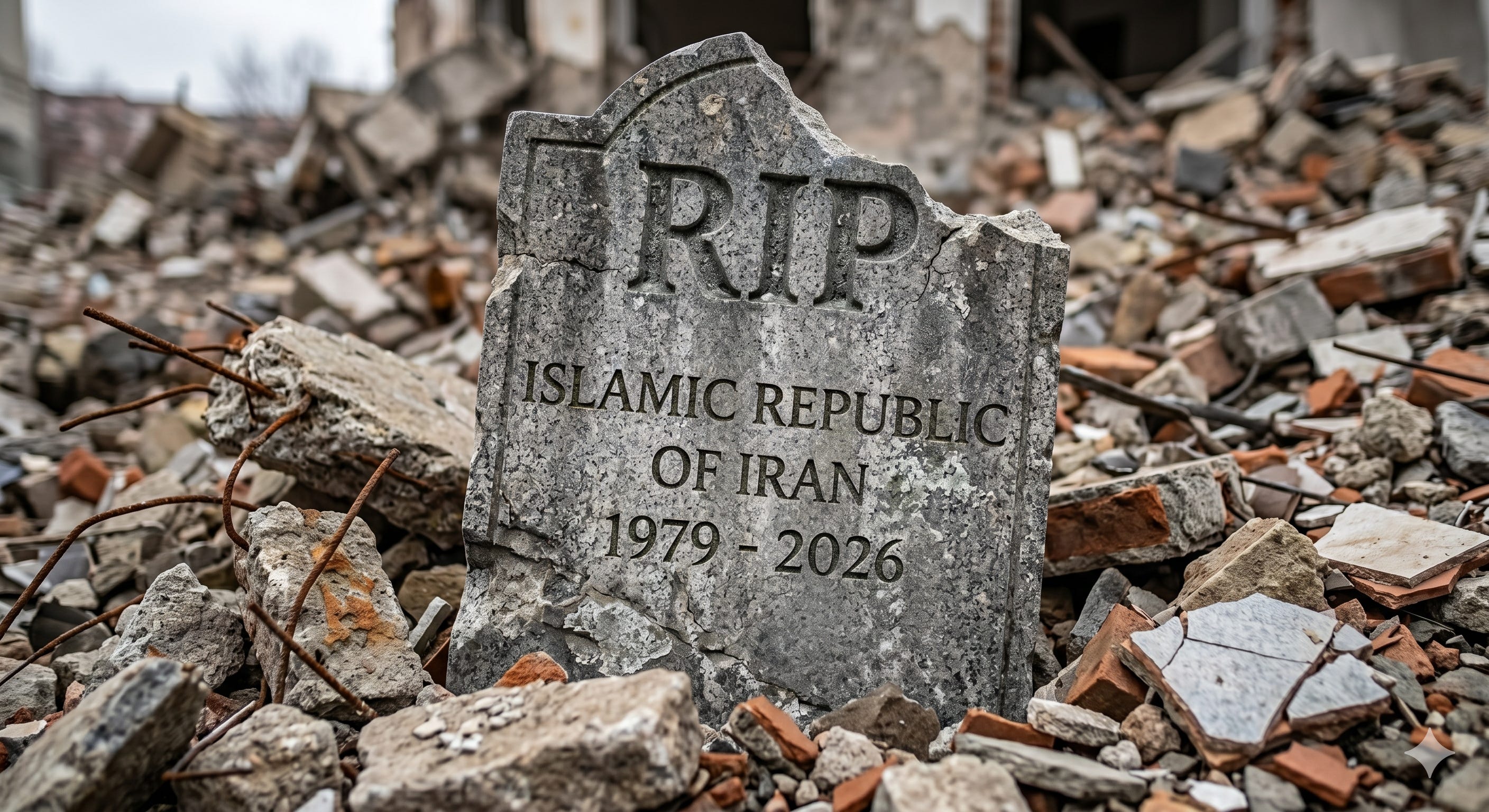
The Islamic Republic "Will Not Survive 2026"
Also, what matters to Israeli voters? And a taste of redemption.
(Gemini AI)
It’s Wednesday, May 6, and according to my colleague at Channel 12, Barak Ravid, within 48 hours, the U.S. expects Iran’s response to a framework that brings both sides closer to a deal than at any point during the war. The proposed pact trades an Iranian uranium enrichment freeze for U.S. sanctions relief, unfrozen assets, and a mutually reopened Strait of Hormuz. This framework is strictly an interim measure; if the final negotiations collapse, a return to all-out war is entirely possible.
Still, it is unfortunate timing. Last night, a very senior Israeli intelligence source estimated that if the status quo blockade remains, the Islamic Republic “will not survive 2026.” Predicting the complete collapse of a half-century-old theocracy within the next eight months sounds like a bold gamble—until you look at the math.
The Iranian rial is in freefall, crashing to 1.8 million to the U.S. dollar. That is a 25 percent plunge from the exchange rate that triggered mass protests just this past January—and it’s only getting worse. To prevent mass starvation, the government is propping up a heavily subsidized exchange rate of 285,000 rials per dollar just to import basic food supplies. The wider economy is faring no better. Even before the blockade, non-oil trade had plummeted by 50 percent. The much-touted economic “pivot to China” has failed entirely, trade is down 80 percent, and regional hubs for evading sanctions, like the UAE, have slammed their doors shut. Two million Iranians have lost their jobs already, and that number is expected to skyrocket.
But the most devastating blow has landed on the regime’s lifeblood: oil.
Right now, Iran has 184 million barrels of oil sitting uselessly on the water. Roughly 60 million of those barrels are physically trapped inside the blockade zone across the Persian Gulf and the Gulf of Oman. The other 124 million are anchored near China, but buyers are too terrified of secondary U.S. sanctions to touch them. Between stalled oil and frozen petrochemical exports, the blockade is draining the regime of an estimated $400 million to $500 million every single day.
Worse, this blockade is rapidly evolving into an existential crisis for Iran’s energy sector. Once Iran’s onshore and floating storage tanks reach 100 percent capacity—which is expected within 15 to 60 days—the state will be forced to physically shut in active oil wells. For mature oil fields, capping wells amounts to a death sentence, as the underground pressure required to extract the oil dissipates. If this happens, Iran could permanently lose 300,000 to 500,000 barrels per day of production capacity. That is $9 billion to $15 billion in annual revenue wiped out.
Iran currently has a surplus of men with guns and a deficit of loyalty. The only things bridging that gap are fear and cash—and when the latter runs out, the former loses its edge. In a desperate bid for survival, the Islamic Revolutionary Guard Corps has begun cannibalizing the state, hoarding whatever liquidity remains at the cost of the rest of the system. Some regular army units and police forces have now gone unpaid for months.
These are not the ingredients for a peaceful transition. The regime will inevitably resort to massacres to keep its grip on power, but there comes a point where desperation will simply override fear. The ultimate result remains the same: the death of the Islamic Republic.
A U.S. guided-missile destroyer enforces the blockade of Iranian ports. (CENTCOM/X)
However, this entire strategy relies on the colossal “if” of the blockade continuing—a foundation built on the most unpredictable ground in global politics: Donald Trump.
Yesterday, Trump suspended Project Freedom, the humanitarian initiative to reopen the Strait of Hormuz via military escort. This pivot follows a direct request from Pakistan and other mediating nations, which convinced the administration to pause operations “for a short period of time” in order to see “whether or not the agreement can be finalized.”
As I noted yesterday, Project Freedom fundamentally alters the regional calculus. By potentially reopening the strait to commercial traffic, it could transform what was once a two-way street of passive economic pressure into a one-way street directed squarely at Iran. The prospect of abandoning this initiative—and worse, reaching a negotiated settlement that hands Tehran economic relief—is exactly what keeps Israeli security officials awake at night.
Fortunately for their sleep schedules, the enemy gets a vote, and the regime is not opting for diplomacy. Iranian attacks on the UAE, in retribution for Project Freedom, continued yesterday, entirely bypassing the desperate objections of the civilian leadership. It appears the internal takeover is nearly complete: IRGC commander Ahmad Vahidi has formed a “military council” that now monopolizes all contact with Supreme Leader Mojtaba Khamenei, effectively blocking civilian leader President Masoud Pezeshkian’s attempts to call an emergency meeting to halt the strikes.
It is entirely possible these strikes are a bluff intended to maximize their bargaining position, but bluffs only work if you are prepared to have them called. By ordering the attack on the UAE, Vahidi’s faction revealed its calculus: a renewed military conflict with Washington and Jerusalem is an acceptable cost of doing business. Men willing to trigger a regional war just to hold onto a bargaining chip are not the kind of men who will see a diplomatic settlement through to the end.
If Israel hopes to sustain the blockade through the end of 2026, there is the unavoidable matter of the American midterms to contend with. Even with kinetic action paused, House and Senate Republicans have reportedly expressed concern to the president over a continuing conflict during an election cycle. Then again, that concern assumes that the midterms are the highest item on Trump’s list of priorities. Ultimately, Iran will be his legacy, and Trump isn’t the one facing re-election.
Voting notes at a voting station in Jerusalem, during the Knesset elections, 2020. (Yonatan Sindel/Flash90)
All the money, attention, and time of every political party is dedicated to one single question: What will the voter think about during those 30 seconds spent completely alone behind the voting screen? The first axiom of campaign science is that while it is difficult to convince people what to think, it is fairly easy to dictate what they think about.
Six months before the polls open, many thoughts are racing through voters’ minds—not just because four years have passed since the last election, but primarily because of the historic era we have experienced: the October 7 massacre, the war against the Iranian axis of evil, the judicial reform and the protests against it. This is all in addition to the perennial topics: the economy, security, a Palestinian state and, of course—“Bibi: Yes or No.”
The “Question of the Week” asked voters to choose two topics currently on their minds. The top issue was the cost of living at 52 percent, but it is worth taking that figure with a grain of salt. It is a well-known fact that Israelis love to tell themselves this is their primary concern, but in practice, it almost never is. Following that were the management of the war (31 percent), replacing Netanyahu (19 percent), and implementing judicial reform and the events of October 7 (15 percent and 14 percent, respectively). Promoting a two-state solution received only 5 percent, coming almost entirely from Arab voters.
The data shows that nearly three times as many voters will head to the polls to ensure Netanyahu is replaced than to ensure he stays. On the other hand, far more voters are motivated to change the legal system than to ensure it remains exactly as it is.
The conclusion? Netanyahu and his camp have yet to find their “element.” If you sum up all “opposition” voting considerations (cost of living, October 7, replacing Netanyahu, etc.), you reach 99 percent. In contrast, “coalition” considerations (keeping Netanyahu, the reform, war management) reach only 60 percent. The genius that brought Netanyahu victory over Shimon Peres in 1996 was his ability to invent, almost out of thin air, a new voting consideration: “Who will divide Jerusalem?” Currently, he lacks such a hook, and the polls reflect that.
One can guess what that consideration might be 30 years later: a government with Arabs. While a large majority of the public wants a government without the ultra-Orthodox, they recoil even more from a government that relies on Arab parties. We already saw a trial run of this strategy this week on the social media feeds of Netanyahu’s advisers (“You chose a crook, you got a terrorist”) and in Finance Minister Bezalel Smotrich’s recent interview. The minister claimed that establishing a government with Mansour Abbas—the leader of the Islamist Ra’am party who joined the previous Bennett-Lapid coalition—“is more severe than the responsibility for the October 7 massacre.” Just as they did 30 years ago, they may ultimately use the Arab Ta’al party leader Ahmed Tibi as their ultimate foil, reviving the old campaign slogan: “Bibi or Tibi.”
The parents of Yishai Slotki embracing their daughter-in-law Aviah at her wedding. (Chaim Goldberg)
Two and a half years after her husband’s heroic sacrifice on October 7, Aviah Slotki—widow of Yishai Slotki—remarried this past Monday.
Yishai and his brother Noam have become two of the most iconic figures of that fateful morning. The brothers were with their families in Beersheba when the Hamas attack began, and without a moment’s hesitation, they headed toward the fighting. Donning their uniforms and armed only with personal handguns and first-aid kits, they drove directly toward the Gaza envelope.
Upon arriving at Kibbutz Alumim, the two began treating the wounded. Security footage later captured their final moments: knowingly charging toward an ambush of heavily armed terrorists to protect their country. Their bodies were discovered on Saturday night, surrounded by fallen terrorists—a final testament to their courage. Their father, Rabbi Shmuel Slotki, later noted: “Noam was secular and Yishai was religious. The story of them fighting together, defending all citizens regardless of religion or opinion, speaks to a fellowship beyond disagreements—a story of brothers who were never parted.”
Aviah Slotki sitting beside the graves of her husband Yishai and his brother Noam. (Chaim Goldberg)
The day before the wedding, Aviah visited Yishai’s grave alongside his family; the very next day, that same family stood by her side as she walked down the aisle.
Standing under the wedding canopy, where Jewish tradition mandates a moment to remember the destruction of the Temple, Aviah spoke of her own personal loss.
“I experienced the destruction of my own private home when Yishai was killed,” she told the gathered guests. “And yet, precisely within that deep sadness and ruin—today, as Micha and I stand here under the chuppa, I feel a taste of redemption.”
English Editor: Ari Tatarka
If you enjoy the newsletter, you can show your support by becoming a paid subscriber—it really helps keep this going. I’m also offering a special monthly briefing for a small group of premium members. I’d love to have you join us—just click below to find out more.
Thanks for reading It’s Noon in Israel! Subscribe for free to receive new posts and support my work.


a deal is dumb, deranged & despicable and so is the Iranian representation on un boards of human Rights and women being oppressed 🤦🏼♀️
the water crisis was dire a year ago yet 🤷🏼♂️
Amit seems to have missed the fact that Trump killed off Project Freedom with a tweet early yesterday evening. Hardly surprising: the US doesn’t have the naval resources to escort vessels through the strait and apparently no ship owners were willing to take a chance on trumps sort of promise of security. Nor were any allies (former allies?) willing to join in the venture. A good thing, since anyone who has followed the war in Ukraine knows that all navy ships are now vulnerable to drone swarms.
I’m not a betting person, but I am willing to bet a large martini that the blockade will be over by the time Trump heads for Peking next week. I don’t think Trump wants to spend two days being yelled at by Chairman Xi. Just my not very humble opinion. Any takers?