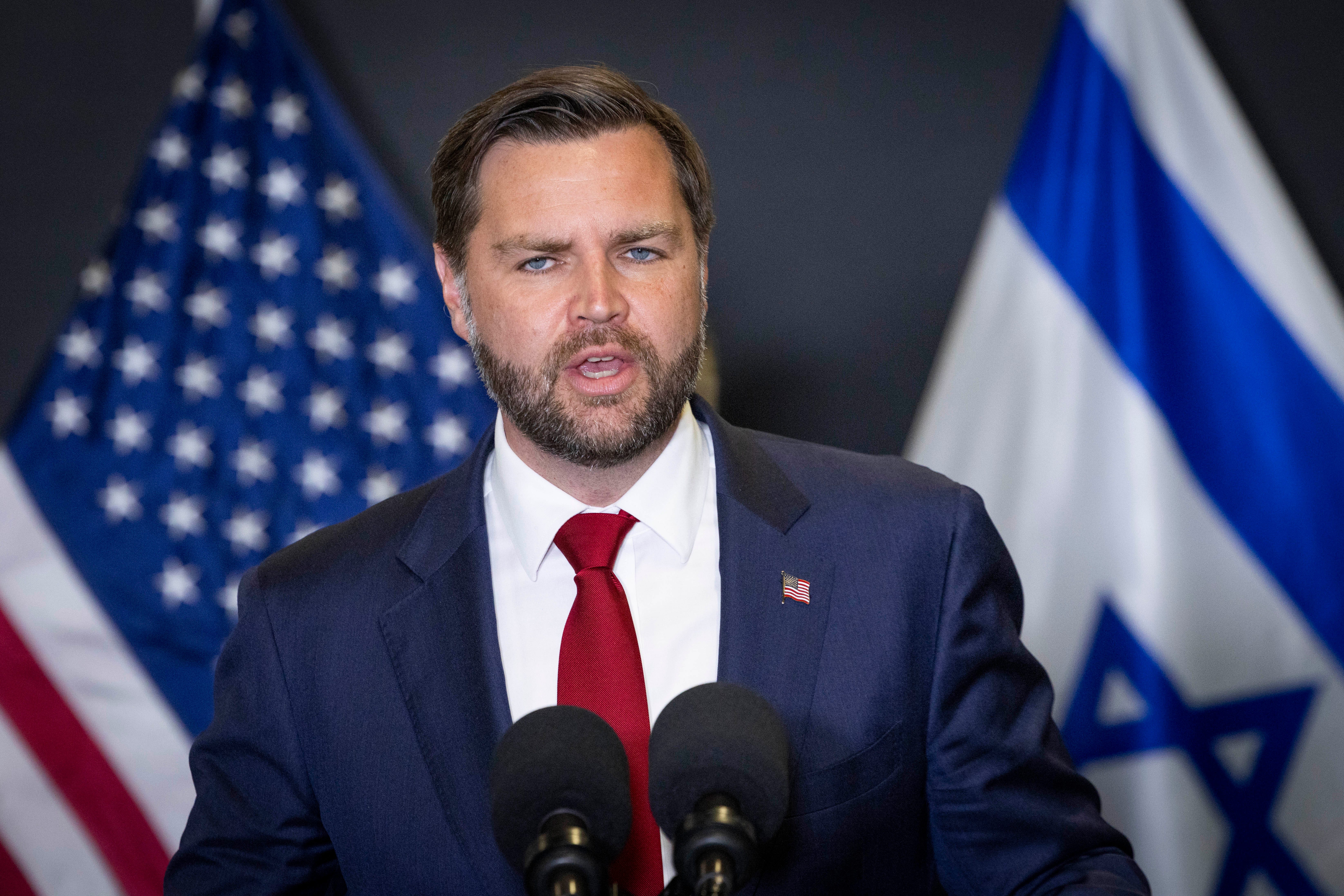
U.S. Vice President JD Vance delivers a statement to the media near Kiryat Gat, on October 21, 2025. (Chaim Goldberg/Flash90)
It’s Tuesday, September 1, and “Vice President Vance played a critical role in the 12-day war,” Bibi’s Trump Whisperer Ron Dermer told a skeptical Republican Jewish Coalition conference last night. “You made the right decision” inviting the vice president to speak, the ex-minister told the crowd. It appears that despite the constant tensions and flare-ups between Israel and Vance, Israel’s America expert believes reconciliation is the right move.
Vance’s own remarks at the conference were meant to be off the record. They didn’t stay that way for long, but what he was trying to hide is unclear—nothing in them was new. He spoke of the “growing suspicion” of the U.S.-Israel relationship among the under-40s, and offered his standard prescription: “What we have to do is articulate why this is in the best interest of the United States of America.” Pushed to denounce his more controversial friends—Tucker Carlson, Megyn Kelly, and his own comments on Joe Rogan—he trained his fire on Nick Fuentes and stopped there. Invoking unity, as he always does, he declined to “cancel” anyone else out of what he believes is the MAGA coalition.
Not exactly a pro-Israel Republican’s dream speech, but nothing he said in Las Vegas, or has said in the past, changes Israel’s calculus. Regardless of who’s on the ticket in 2028 or in Israel’s prime minister’s office, Israel is voting Republican.
Consider Israel’s best case scenario. In a massive upset, Pennsylvania governor Josh Shapiro beats AOC for the nomination by a large margin without denouncing Israel in the process; the gravity of his party and his base will still drag him to the “sensible middle” of the Democratic position on Israel. Where exactly that sits is unclear, but we know for certain it is well to the left of Obama’s quickly broken 2008 vow that he would “never compromise when it comes to Israel’s security.” Yair Lapid can attack Netanyahu for “losing the Democratic Party,” can fly to Washington and make overtures toward winning it back—but were he the one in the Prime Minister’s Office, he too would take an Israel-skeptical Vance over a sanction-happy Shapiro every time.
Would Vance be Israel’s pick in a Republican primary? Unlikely. But Israel isn’t looking to fall in love with a candidate. It’s looking for allies—and when it comes time, it will fall in line accordingly.
Given the distinct possibility of a Vance ticket, Israel needs to step carefully over the next two years. Even with arrangements like the MoU, it would do well to take Dermer’s advice from that time, ”take a deep breath and think”. You attract more flies with honey than vinegar. Israel has leverage in this relationship; few in the administration are more worried about the divide over Israel than Vance himself. For all his courtship of the coalition’s more questionable elements, there is no Republican coalition without its pro-Israel wing, and he knows it. His own friends will write conspiracies about why he showed up in Las Vegas, but he showed up because he needs those Jewish Republicans too.
Israel wooed Trump with a golden pager and a bestowal of the Israel Prize. It will have to learn to speak to Vance in a different language, but dialogue is entirely possible.
Head of Ra'am Mansour Abbas holds a joint press conference with new party member Yoav Segalovitz in Nazareth. August 31, 2026. (Michael Giladi/FLASH90)
It finally happened. Despite a few recent bumps in the road, the Islamist United Arab List has welcomed its first Jewish member: former senior police commander and Yesh Atid MK Yoav Segalovitz. Has Segalovitz joined the jihad—or come to drag the party in a more Israel-friendly direction?
One does not simply walk into an Arab party whose first electoral slogan was “Allahu Akbar, Al-Aqsa is ours.” Since his 2021 breakup with the Arab Joint List, Mansour Abbas has been trying to merge his party into the mainstream of Israeli politics—first through negotiations with Netanyahu, who was open to an alliance until Smotrich blocked it, then settling for a seat in Naftali Bennett and Yair Lapid’s short-lived government. That year he took the step—unprecedented for an Arab politician—of declaring that “Israel was born as a Jewish state and will remain so.” It wasn’t enough to keep Bennett’s right flank from defecting and collapsing the government, but Abbas was undeterred.
Since that collapse he has worked harder to rebrand Ra’am as moderate enough for even Israel’s right to stomach: breaking last year from its parent Islamic Movement, an offshoot of the Muslim Brotherhood, and now allying with Segalovitz.
Yet the political marriage stops well short of going “all the way.” Segalovitz will run on the list but will not become a member of Ra’am—an arrangement that hands both men their deniability. Segalovitz can quietly drop his opening condition for membership that Abbas recognize Israel’s Jewish and democratic character “in the spirit of the Declaration of Independence.” Abbas, for his part, keeps to his status quo of accepting the Jewish state in practice but never in principle, and need not explain why he has bolted a Zionist Jew onto his technically non-Zionist list—advertising the arrangement to his base not as moderation but as the acquisition of Segalovitz’s police experience as a remedy for rampant Arab gang crime.
In the end it is as Segalovitz says: “I don’t intend to change Mansour and Ra’am, and they won’t change me, but we can cooperate politically on the basis of trust, recognition of difference, and joining together in shared work.”
Which raises the question: if you’re not there to meaningfully make the party more Zionist, what are you doing there? Abbas has the answer. The list, he says, is intended to be “the complementary part that ensures the fall of the right and the replacement of the far-right, racist government with a government in which we will be a part.”
Can one really dispute Likud Knesset Speaker Amir Ohana’s assessment that the move is “intended to achieve one thing—to legitimize the inclusion of an Islamist list in an Eisenkot government,” whose members, as he adds, cannot bring themselves to say “Hamas is a terrorist organization?” I put that very question to Abbas myself; he told me he couldn’t answer it—in his own words, for fear of assassination. The rest of his party does it out of principle.
Will Segalovitz’s presence be enough to kosher Abbas for a coalition? It’s much the same question as whether a few Jewish friends kosher an anti-Israel candidate, and the answer is much the same: if you think the ideological concession is a price worth paying to fight the larger enemy, then probably yes. For the rest of Israel, no shade of Segalovitz lipstick will make non-Zionist pork kosher.
Children arrive for their first day of the new school year at Shahar Eshkol Elementary School in the Eshkol Regional Council, near the Gaza border in southern Israel, September 1, 2026. (Tsafrir Abayov/Flash90)
Across the country, school is back in session, and I, like other Israeli parents from north to south and left to right, couldn’t be more relieved. But for all the joy of balloon arches, smiling teachers, and tears of joy and nervousness from parents and children alike, all are asking the same question: will this finally be a normal year?
The parents who brought their children to the school gates in 2019 knew to expect them to be sent home so the parents could take the school in their stead, to vote. What they didn’t expect was that afterward, the children wouldn’t be able to return. Schools shut on March 13, 2020, and 2 million students were pushed onto Zoom. Three lockdowns followed.
By the autumn of 2023, after two years of pandemic and three trips to the ballot box, a normal year finally looked possible. The children broke for Sukkot, due back once the holiday ended. Instead, on Simchat Torah—October 7, 2023—the war came, and for much of the country the classrooms remained empty for the better part of two months.
For the children of the borders, the classrooms were quiet for significantly longer. At the peak some 253,000 Israelis had been ordered or driven from their homes. The southern families began trickling back within months; the northern ones did not, and opened a second school year in exile before the November 2024 ceasefire let them even weigh returning.
Perhaps 2025 would be the year, parents let themselves think. They managed a good five months—until Roaring Lion sent them home for a month, feeding into the Passover break.
An Israeli child who started school as COVID arrived has finished all of elementary school and is halfway through middle school without ever sitting through a single uninterrupted year. The interruptions have manifested in sharply declining outcomes—made worse by the constant interruptions of sirens and the stress of hundreds of thousands of parents pulled away for reserve duty.
As a father who dropped off four children this morning, I feel, beneath the relief, a tremendous sense of optimism. I cannot help but hope that perhaps this, at last, after seven years of war and pandemic, will be the year my children, and all of Israel, return to normal life.
English Editor: Ari Tatarka
If you enjoy the newsletter, you can show your support by becoming a paid subscriber—it really helps keep this going. I’m also offering a special monthly briefing for a small group of premium members. I’d love to have you join us—just click below to find out more.
Thanks for reading It’s Noon in Israel! Subscribe for free to receive new posts and support my work.


You do understand that closing the schools during covid was totally unnecessary. I will never understand why Israel blindly followed the US in that one.
As much as I follow what is happening in Israel I did not realize the totality of the length of school closures. It is devastating. I taught in NY during COVID. It was a disaster for the children. I pray that these children can withstand the damage and recover. My heart breaks for them and their parents. Israelis make the enormous sacrifice for all of us and we need to support you as much as we can. Thank you for your reporting. It helps bring us closer to being in Israel and understanding what is happening.