


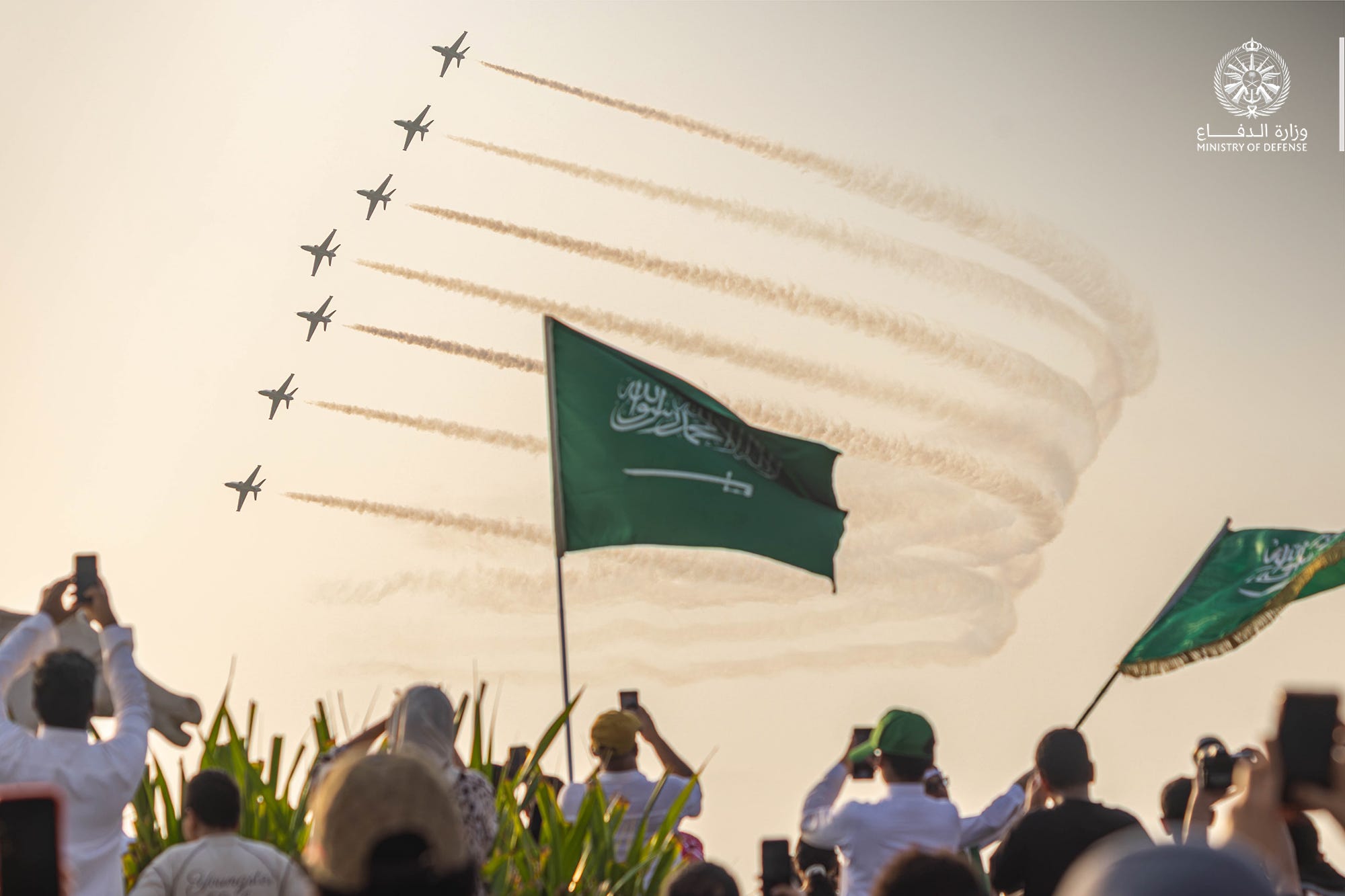
The Saudi Air Force showcases formations and aerial displays in the skies of Jeddah to celebrate Saudi National Day, September 2026. (X/@modgovksa)
It’s Sunday, October 11, and last night at least 12 people were killed and 309 wounded in a Houthi attack on Riyadh’s King Khalid International Airport. Saudi Arabia’s response is unlikely to prioritize the “protection of civilians, and self-control” as it encouraged Israel to do in the wake of October 7. But nor, to its great detriment, will it take the Israeli route: the one that leads to lasting security.
The strike comes a week into Operation Dawn of Yemen, a Saudi-backed offensive by Yemeni government forces against the Iranian-backed Houthis. With the help of some 100 Saudi jets, government-aligned forces have already retaken key stretches of coast along Bab el-Mandeb. But even as the Houthis are hard-pressed, and Yemeni officials talk optimistically of driving all the way to Houthi-held Sanaa, the Saudis are keeping one eye on the rearview mirror.
After joining the Iran war late and hesitantly, firing their first missiles at Israel only a month in, the Houthis largely held their fire against the Jewish state and found a much softer target in the Gulf monarchy. In July they declared a naval blockade on the kingdom. Riyadh’s response has typically been tepid: limited airstrikes and quiet diplomacy.
That has long been the Saudi playbook. Even at the height of its war on the Houthis, the kingdom kept one hand extended. In 2019, after Houthi-claimed drone strikes on its oil facilities, it said it viewed a Houthi truce offer “positively.” In 2020 it told the Houthis, through back channels, that it would sign a UN-brokered nationwide ceasefire in exchange for a buffer zone on its border. In 2021 it publicly offered a ceasefire and the reopening of Sanaa airport, with its foreign minister declaring “it is up to the Houthis now.” Since the 2022 truce, the kingdom has largely halted offensive operations even in the face of sporadic provocations. Even when the United States and Britain began addressing the Houthi problem in January 2024, Riyadh called for “self-restraint” from the sidelines. As recently as mid-September, with the Houthis fresh from seizing Mocha, the kingdom reportedly offered them a two-week ceasefire and direct talks through Omani mediators.
Rather than a new dawn for Riyadh’s Yemen policy, this war is simply a means to negotiate. After the Houthis’ advance last month, Riyadh concluded that it could not enter new talks while the Houthis held Bab el-Mandeb. Without U.S. support, it will likely declare victory if it simply pushes the Houthis off the Red Sea coast and restores quiet.
If this mowing-the-grass strategy sounds familiar, it is because the kinship between the Houthis and Hamas runs deeper than shared enemies and sponsors. Both terror groups have been the object of a far more technologically advanced neighbor’s conceptzia: the belief that an enemy sworn to your destruction can be bought off or contained.
In place of suitcases of Qatari cash, Riyadh reportedly paid Houthi civil servants out of its own pocket. And when the Houthi flood came, it dwarfed October 7. Instead of several thousand gunmen, some 100,000 fighters reportedly massed without Saudi intelligence noticing, then swept down the Red Sea coast in September and seized Bab el-Mandeb.
This is where the two countries diverge.
Surveying the destruction of its territory, Israel understood that such a threat could not be allowed to rebuild on its border, and, despite American misgivings, went about uprooting Hamas. The Saudis, looking at their burning tankers and smoldering oil facilities, also resolved that the situation had to be dealt with. So they called Washington for help, were rebuffed, and settled for a particularly aggressive round of mowing.
The gap is starker still on what should have been a shared revelation for Riyadh and Jerusalem: Iran. Israel’s strategy has been criticized at home for fighting the tentacles rather than striking the head of the octopus. Saudi strategy deserves harsher criticism: it fights a tentacle while negotiating appeasement with the head. Despite Iran’s fingerprints being all over the Houthi escalation, the Saudis are still seeking an accommodation with the creature.
Perhaps Israelis should thank Moses for bringing us to the only area in the region not overflowing with oil. Lacking vast natural resources, and with them an indispensable place on the world stage, Israel has never comfortably settled into the role of a status quo power. In the rare moments it slipped into such complacency, it was brutally reminded that the status quo is one in which it is surrounded by enemies eager to overturn its status as existing. Constant struggle for survival is practically a core tenet of Zionism.
That Israel has never had the luxury of the status quo lies at the root of what separates it from many of America’s allies, and from America itself. It is why the Houthis will happily strike King Khalid International Airport but now think twice about Ben Gurion. It is why the Saudis will not try anything without Washington holding their hand, while Washington grips Israel’s for dear life to keep it from upending the status quo.
That fear of a new Middle East is the great achievement of Iran and its proxies: without a nuclear weapon, they have built a Cold War-style balance of terror that much of the West fears to provoke.
The Houthis in the mountains of northern Yemen present a different challenge from Hamas in its tunnels under Gaza, but the lesson of appeasing terror is the same. If the Saudis want to find themselves safer five years from now, they should start reading up on Zionism.
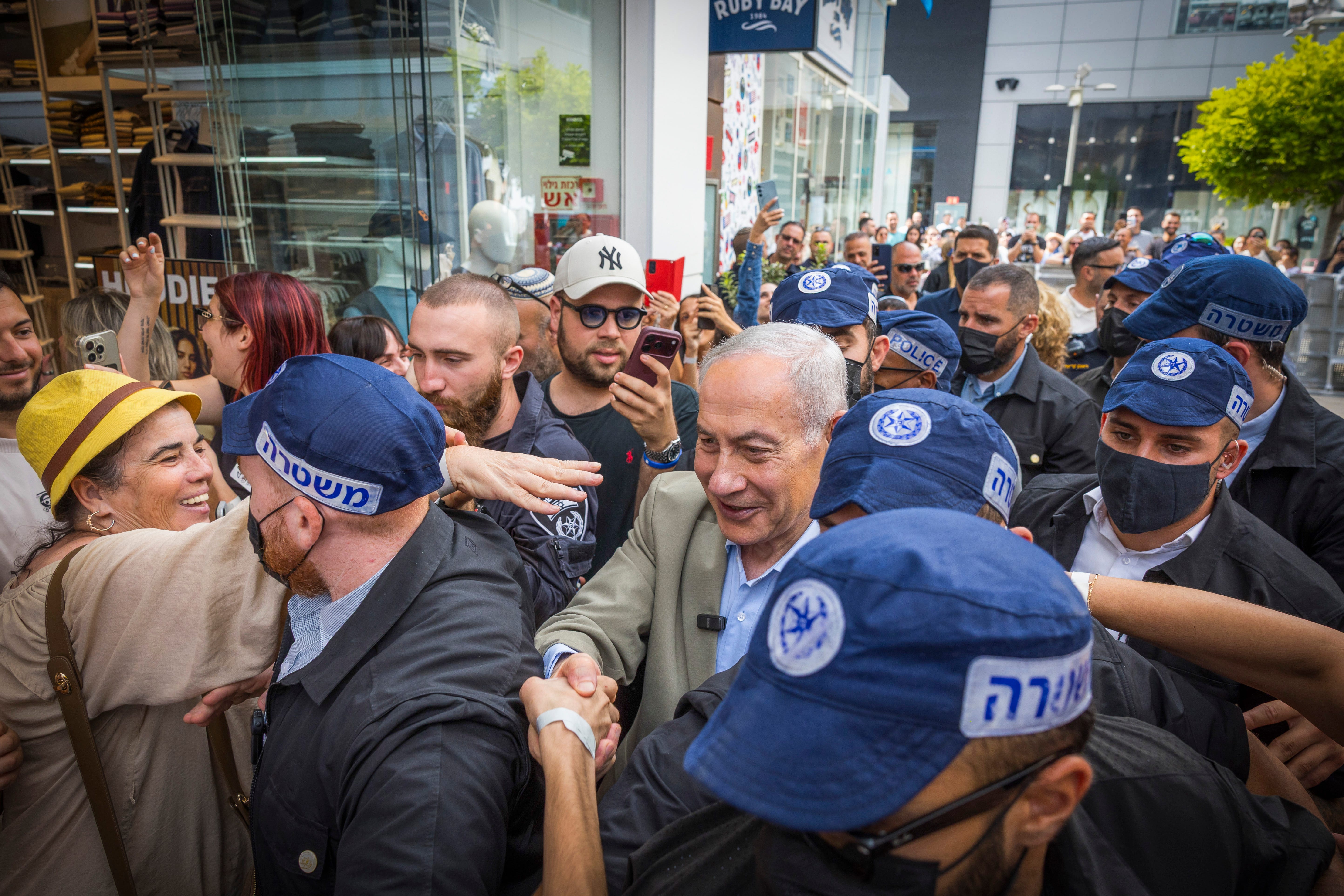
Israeli Prime Minister and Likud party chairman Benjamin Netanyahu, surrounded by supporters, during an election campaign tour in the southern Israeli city of Ashdod, September 29, 2026. (Liron Moldovan/Flash90)
Does a terrible, traumatic national event need to sit at the center of an election campaign in order to hurt Benjamin Netanyahu’s chances of being elected prime minister? The reference here isn’t to blaming Likud for the October 7 massacre in the 2026 election, but to blaming Likud for Prime Minister Yitzhak Rabin’s assassination in the 1996 election. The rival candidate’s gut screams “yes.” But the gut is a terrible strategic advisor that has already lost quite a few elections. Blaming the entire right for the assassination caused people to rally around Netanyahu, not abandon him.
The massacre’s story is more complicated, on two fronts. First, the opposition has a far more popular argument against Netanyahu: his partnership with the Haredim. Dwelling on the massacre, the supposed warnings that preceded it, and other fateful security questions could turn out to be hammering the wrong nail. Second, the debate over October 7 pits the two camps’ foundational arguments directly against each other. Gadi Eisenkot, the former IDF chief of staff, and his allies say: the failure of October 7 wouldn’t have happened on our watch, and the successes from October 8 onward would have happened regardless of who was in charge. Netanyahu says: the failure of October 7 could have happened to anyone, and the successes from October 8 onward wouldn’t have happened under Eisenkot and his allies’ leadership.
The Kantar Institute poll reveals something instructive: both sides are offside. A majority of those with an opinion, 42 percent to 28 percent, believe the failure would have happened under a change government too, perhaps because of the long-running, multi-player conception behind it. Even in the opposition, about a third of those with an opinion think so, which suggests most of the voters still torn between the two blocs hold this view as well.
By contrast, only a quarter of the public, 25 percent, backs Netanyahu’s claim that his rivals would have achieved less in the war. Fifty-six percent believe they would have achieved the same results, or better.
These are dramatic numbers, and they explain a lot about the campaign so far. They raise a huge question mark over the opposition’s decision to spend the final month focused on reports of Egyptian or Emirati warnings to Netanyahu before October 7, and they explain why the opposition has actually lost altitude this past month. They also explain why Netanyahu shelved the “We Won’t Surrender” campaign in favor of “Right or Palestine.” The public doesn’t rate the war’s achievements very highly, or else credits them to the IDF’s performance rather than to any particular government.
Above all, there’s a fairly bleak conclusion here about the public on the eve of what’s being called (mistakenly, in my view, as noted) “the most fateful election in the country’s history”: voters see the two most dramatic events in Israel’s history, the October 7 massacre and the War of Resurgence, as events over which leaders have only very limited control.
English Editor: Ari Tatarka
If you enjoy the newsletter, you can show your support by becoming a paid subscriber—it really helps keep this going. I’m also offering a special monthly briefing for a small group of premium members. I’d love to have you join us—just click below to find out more.
Thanks for reading It’s Noon in Israel! Subscribe for free to receive new posts and support my work.


Wonderfully written. I subscribe to a relatively high number of Substack and other newsletters and Amit’s is by far the best, with Bari’s The Free Press, second.
As an American and I know we should not comment on Israeli elections but Amit you touched on the third rail in your second piece - the Haredim. If I were in the Opposition, this is the rail to step on because it’s the internal existential threat to the country. Haredim must send their children to the army. And with the brain drain, the country will not be able to financially support the Haredim without some limits on what percentage of the budget they receive in support. The Opposition will lose if they don’t make this their central theme. It’s the only issue in which a Bibi supporter would flip to an alt candidate….