The War of Optics
Also, a fake constitutional crisis, and former hostages get married.
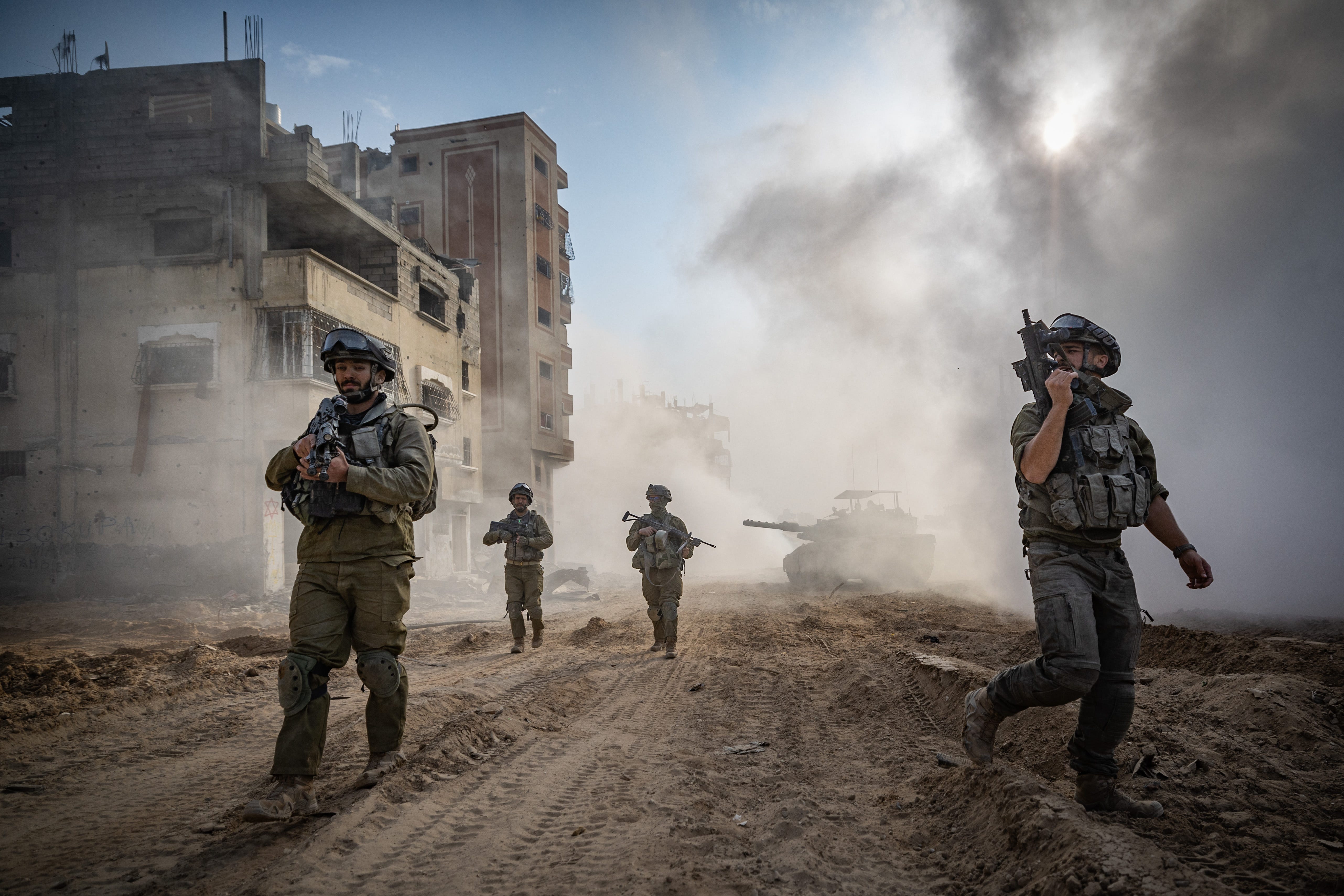
Israeli soldiers during a military operation in the Gaza Strip, December 2023. (Yonatan Sindel/Flash90)
It’s Monday, July 6, and there is something very strange about modern wars. One day you bomb the enemy, and on the second day he calls you on WhatsApp after getting the internet working again. We tend to look at the absurdity of senior American administration officials conducting friendly conversations with the heads of the terror regime. But it is safe to assume that for the Iranians it is harder. They need to talk with the people who killed their admired leader and caused their economy hundreds of billions of dollars in damage.
In the first two weeks after the signing of the agreement, there was an almost absolute consensus that Iran had won. This feeling of catastrophe was caused by a rare coalition of the regime’s mouthpieces in Tehran, the establishment media in America and the hard feelings in Israel and within the Republican Party.
If things are so good for Iran, why did they fire at the beginning of the week in the Strait of Hormuz? The accepted approach is that the regime is simply taunting Trump out of hubris and an absolute conviction that he will not dare to attack back. But a senior American official offers an additional possibility: “The Iranians are shooting because it turned out that they are losing: they thought they would open the strait from their side immediately, and in parallel slow down access for Western vessels. In practice, the opposite happened. We have safe passage under ‘Project Liberty,’ without them controlling it at all. Meanwhile, despite the temporary suspension of the sanctions, it became clear to them that no bank in the West is willing to do business with them for two months. They are offering steep discounts, but have not sold even one barrel of oil. In addition, no asset was unfrozen. The Gulf states have no desire to lift a finger for them.”
And yet not everything is measured in oil, but also in optics. The Americans believe that what they did in the agreement is to give the moderate wing there an incentive against the extreme side, and to see what will come out of the clash between them. They see the power struggles at the top as one of the achievements of the war and believe that something good can still come out of the skirmishes.
Give us credit, the Americans ask again and again. Just as you did not believe that Hamas would give up the hostages, you also do not believe that Iran will give up its nuclear program. Force solves many things, but contrary to what the Israeli government and its leader think, it does not solve everything. The war has reached a stage in which the marginal utility of using it is steadily decreasing. We are not naive as you think, nor are we “Innocents Abroad,” like the title of Mark Twain’s book about his journey to Palestine in the 19th century. In Hebrew, by the way, the book is called by the somewhat cynical name “A Pleasure Trip to the Holy Land.”
This is an excerpt from my weekly column in Israel Hayom.
Israeli Prime Minister Benjamin Netanyahu speaks with Minister of Communications Shlomo Karhi during a 40 signatures debate, at the plenum hall of the Knesset, January 2026. (Yonatan Sindel/Flash90)
According to ABC, “Israel constitutional crisis looms,” while Kan disagrees, contending that “the constitutional crisis has arrived.” Well, I’m sorry to disappoint, but we aren’t there yet.
In political discourse, the term “constitutional crisis” gets thrown around a lot, but it has a technical meaning: a situation in which a public or elected official faces two conflicting legal obligations that cannot both be satisfied—typically when complying with a court ruling would require disobeying another binding legal authority, such as the legislature or the constitution itself, leaving the official with no lawful way to act.
A constitutional crisis would look like this: Disputed State Comptroller Michael Rabello arrives at the office on a Sunday morning demanding entry as the rightful comptroller, while the court has ordered that the door stay shut. The security guard standing there faces the real crisis, forced in that exact moment to choose between two competing authorities: the Knesset that elected Rabello and the Supreme Court that ruled his election invalid.
Let’s examine the current “crisis.”
It began when Israel’s Supreme Court stepped in to stop the government from installing its own picks on the Second Authority Council, the body that regulates commercial television and radio. The judges blocked Communications Minister Shlomo Karhi from appointing his chosen candidates to lead the watchdog, ruling that his selection process appeared rushed and politically motivated. Six members of the 15-person council resigned immediately after that ruling, leaving the body short of the two-thirds quorum it needed to function. The court then concluded that the mass resignation amounted to a deliberate attempt by Karhi to paralyze the watchdog from within, so the judges ruled that the six departed members shouldn’t count toward the total required for quorum. That reasoning let the remaining nine members vote legally, even though the law, on its face, requires votes from 10 of the original 15. The government argues the court effectively rewrote the statute to reach the outcome it wanted and has responded by formally refusing, through every legal means available, to recognize any decision made by this reduced nine-member council.
But it’s worth being precise about what that refusal actually means. The order in question isn’t directed at the government at all—it doesn’t instruct the government to do something it’s now refusing to do. The real subject of that order is the council members, not the state. Instead, as the government itself has clarified, it is simply saying: “We disagree with the court’s ruling and are calling on the members of the Second Authority Council not to convene.” It wasn’t even a binding resolution—closer to a tweet than a line in the sand. Setting aside any genuine disagreement with the ruling, with primaries approaching, plenty of people stand to benefit from the statement and the alarmist headlines that followed. More than a few Likud primary voters would love to see the court rebuffed. But despite the reaction, as it stands, we remain several serious steps away from an actual crisis.
Supreme Court President Yitzchak Amit and Supreme Court justices arrive for a hearing at the Supreme Court in Jerusalem on petitions seeking to overturn the election of attorney Michael Rabello as State Comptroller, June 28, 2026. (Chaim Goldberg/Flash90)
Having said that, I think the time has come to ask something of the court. Clearly, the Knesset and the government must be subject to the law. My only question is: What are the limits of the Supreme Court’s power of interpretation?
Last week, Justice Noam Sohlberg used a wonderful analogy, citing a Talmudic saying about “a child who is neither foolish nor exceptionally clever”—an average child. Such a child serves as the standard for understanding the plain language of a statute: neither reading too cleverly into it nor missing what’s obvious. So if the law states that the Council of the Second Authority may not convene except with two-thirds of its 15 members present, I don’t believe I’ve met a single average child who would read that as referring only to two-thirds of those who happen to still be voting.
In the world I grew up in, courts ruled according to what was written in the law. If the statute describes a headcount, then let the Supreme Court teach us, once and for all, where it derives its differing reading from. Justice Yitzhak Amit, for example, has taught us that there’s one rule for one government and another rule for a different government because, apparently, there exists a principle dividing good governments from bad ones. Others have taught us that a Basic Law can be struck down over some overarching supra-constitutional principle.
I’d very much like the Supreme Court to explain, clearly and once and for all, exactly where it derives these interpretive powers from. Otherwise, we’re left with an uncomfortable double standard: outrage whenever the government or the Knesset bends the law, and silence—or worse, applause—whenever the Court does the same.
President Isaac Herzog and his wife, First Lady Michal, giving Sasha and Sapir Troufanov a blessing at their wedding.
Some 17 months ago, Sasha Troufanov walked free after more than 400 days in Hamas captivity. Last night, he married Sapir Cohen, the woman he never stopped hoping for, even when he believed he would never come home.
The couple had only just moved in together, ready to start a life together, when, on October 7, 2023, they went to visit Sasha’s family in Kibbutz Nir Oz. During their visit, terrorists broke into the home and stabbed Sasha in the shoulder. Sapir wrapped herself in a blanket and hid beneath a bed—but they found her anyway. Sasha’s father, Vitaly, was murdered during the attack. Sasha, Sapir, Sasha’s mother, Yelena, and grandmother, Irena Tati, were all taken hostage.
What followed was a separation defined by uncertainty. Sapir was released two months later, during the November 2023 ceasefire, not knowing whether Sasha was still alive. For Sasha, the nightmare stretched on for more than 400 days. He was shot in the legs by his captors, and by the time he was finally freed in February 2025, the injuries had gone untreated for so long that he needed extensive medical care just to begin healing.
And yet, in the depths of captivity, not knowing if he would ever see the sky again, Sasha’s thoughts weren’t of himself. They were of Sapir.
At a press conference shortly after his release, Sapir shared, her voice breaking, what he had told her that first night home: that he had prayed for her to find someone else to love. He didn’t want her waiting for a man he was certain would never walk free again. He didn’t believe, in the darkest hours, that survival was even possible for him. She waited anyway.
A few months after coming home, Sasha proposed.
Last night, standing before the people who had carried them through it all, Sasha looked out at the guests—many of them fellow survivors of captivity—and said simply:
“I want to thank you for coming today to share this joy with us, this evening, this emotional moment. You’ve been with us every step of the way. Thank you so much. I love you.”
English Editor: Ari Tatarka
If you enjoy the newsletter, you can show your support by becoming a paid subscriber—it really helps keep this going. I’m also offering a special monthly briefing for a small group of premium members. I’d love to have you join us—just click below to find out more.
Thanks for reading It’s Noon in Israel! Subscribe for free to receive new posts and support my work.


We Jews haven’t had a whole lot of joy to cry over these last almost 3 years, but today I cried with joy seeing this picture and story of the resilient love that Sasha and Sapir shared with the world. Ahm Yisrael Chai.
Our Judicial system is approaching crisis. It is high time a procedure, subject to ultimate accountability to the Knesset is acted upon. This undertaking should not impinge on the judiciaries' independence alike of the government, and to a large extent of the Knesset.