Three Options for Escalation
Also, a look at the game on the ground in Judea and Samaria, and Israel loses its Walter Cronkite.
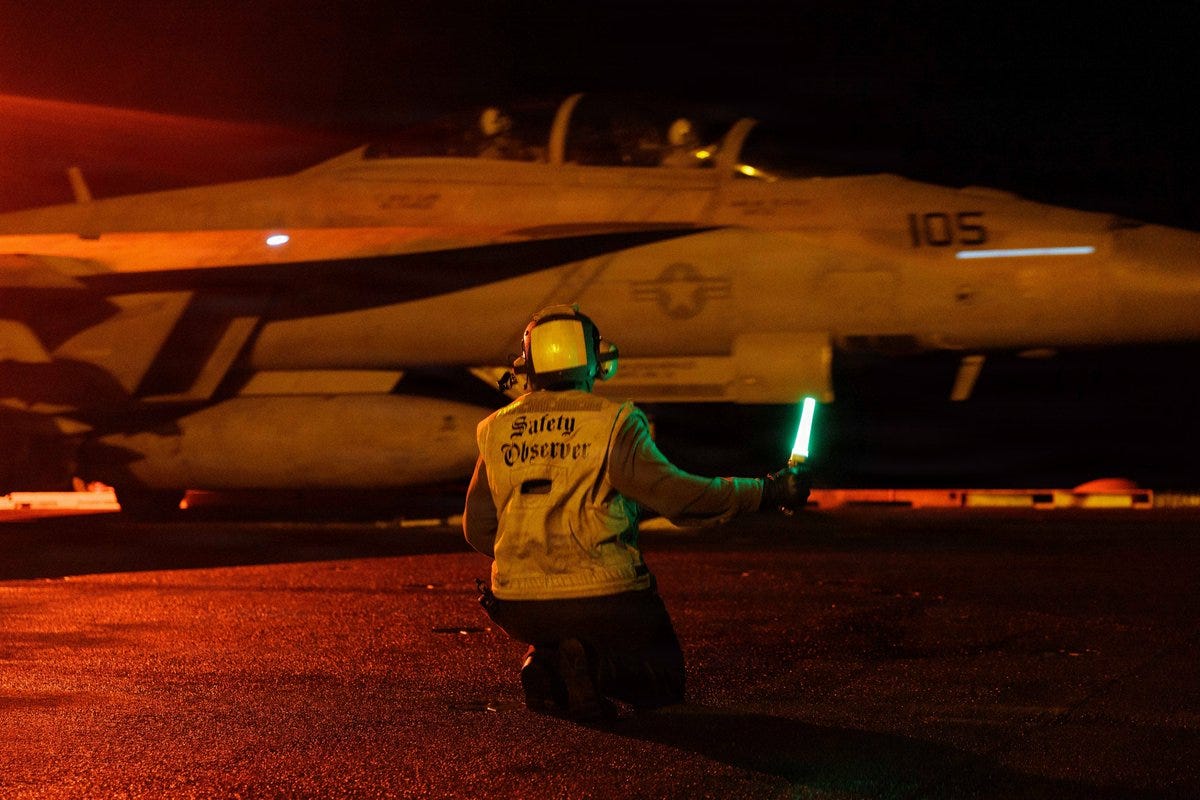
U.S. Sailors signal an F/A-18E Super Hornet on the deck of USS George H.W. Bush as the aircraft carrier transits the Arabian Sea. (CENTCOM/X)
It’s Friday, July 24, and a massive escalation with Iran appears imminent. Let’s look at the hints.
Over the past few weeks, dozens of U.S. aerial refueling aircraft have landed in Israel, and special operations forces have deployed to the region. Squadrons of fighters have been staged across the Middle East, and bombers at bases in the United States and the United Kingdom sit on high alert, ready to ramp up operations, according to The Wall Street Journal.
Israeli alert levels are, meanwhile, at their peak, with the Air Force and the Intelligence Directorate singled out. Home Front Command soldiers have been told to expect call-up orders; reservists and the recently discharged have been notified. Municipalities have begun reopening public shelters across the country, and it was recently revealed that Mossad Director Roman Gofman visited Washington roughly two weeks ago to meet with CIA Director John Ratcliffe and White House officials.
The Houthis, for their part, declared a blockade of Saudi Arabia, threatened the Bab al-Mandeb Strait, and then hit two Saudi tankers. With a second of the world’s great choke points now in play, the pressure to act decisively rises accordingly.
Then there are the words of Donald Trump, at once the most and the least reliable indicator of what is coming. “I am considering a massive attack. Bigger than ever before. I am close to making a decision. We are all set for it,” he said yesterday.
That “massive attack” will likely fall into one of three buckets.
The first is Iran’s energy infrastructure—the operation that was on the table before Trump declared a ceasefire. Israel had begun pursuing it during Operation Roaring Lion until Trump reportedly pulled the brakes, under pressure from Gulf states with a well-founded fear for their own energy industries. The target set is narrow and thoroughly understood. Kharg Island handles the overwhelming majority of Iranian crude exports; a few missiles in the right place and Tehran has no way to sell its oil. Choose this option and the Iranians are left cash-strapped and reeling—and overwhelmingly likely to retaliate against regional energy infrastructure, and perhaps against the desalination plants the Gulf depends on for its water.
The second is direct action against the nuclear program itself. That could mean targeting senior figures, seizing the enriched uranium, or some other step aimed at the core of the program. Pickaxe Mountain would likely be the primary target. The site is buried deep enough that it is widely assessed to lie beyond the reach of bunker busters, which is why “seizing” rather than “destroying” keeps surfacing in the discussion. The Iranian response to an attack on their nuclear facilities would be severe as well, though significantly less severe than an oil crisis.
The third is the Strait of Hormuz: a major offensive against the Iranian capabilities surrounding it—anti-ship missile batteries, the IRGC Navy’s fast-attack craft and mine stocks, and coastal radar and drone sites. Throughout the war, it was barely on Israel’s radar. It is now perhaps the single most important question in the global economy. But even such an operation still won’t open the strait. All it takes is one IRGC operator left alive with a drone or two to send war-risk premiums through the roof and shipping companies in the opposite direction. Regardless, Trump may simply declare the strait open and call it a day, with the best-case scenario being a follow-up escort operation organized with European help.
What’s interesting is that some of these operations don’t require Israel’s involvement at all. Trump said so explicitly: “We don’t need anybody.” He also teased the opposite possibility, saying Israel “would join in two minutes if I ask them to,” and that there would be consequences if it did. Could the conflict intensify dramatically elsewhere while Israel largely stays out of it? At first glance, that seems unlikely. Israel is, after all, only the Little Satan. But even the Little Satan is still Satan.
On the other hand, the past few weeks have produced some confusion among the Israeli population. There are missiles and drones flying across the region, and they aren’t the target? While Kuwaiti vacation plans have been entirely put on hold, Israelis are still flying back and forth on a daily basis. It defies the historical pattern entirely. Israel has become a place of quiet in the middle of a hurricane sweeping across the Middle East.
Still, whether it remains so depends entirely on Trump. He has a ticking clock in the form of the midterm elections. As this war continues to plunge in popularity, Trump appears desperate to wrap it up, though I would caution the president that the only thing less popular than continuing an unpopular war is losing an unpopular war.
Me meeting with Itamar Cohen at his farm on Tuesday.
Terror in Judea and Samaria rears its head. At least one Israeli was killed, four others were wounded, two of them seriously, in a shooting near Gilad Farm, this morning.
“Aren’t you worried?” I asked Itamar Cohen at his farm, between Nablus and the Jordan Valley. “My five-year-old herds the flocks here,” Cohen told me. “And that’s enough?” I asked, picturing my own child leading 200 cows alone. “He doesn’t go alone. The seven-year-old goes with him.”
The frontier where these farms sit is a place with somewhat different rules. The rules used to be set by the Arabs, and in this area Hamas operatives trained undisturbed. Now the narrow road is blocked by fat-fleshed cows driven by scrawny Jewish boys.
“It’s like a giant game of Tetris,” the farmer tells me as we look out over the Tirza Valley. This is the route, heading west, by which the Israelites entered the land, according to the Bible. Today the Tetris being played in this valley is between two bodies of wildly unequal dimensions: the European Union on one side, the Farms Association on the other.
To be precise, it isn’t Tetris but the primitive game Xonix, where you have to close off territory while a ball tries to hit you (in my childhood we called it “area-closer”). Close off the area and it’s yours. Judea and Samaria is divided into balloons—Palestinian Areas A and B, Israeli Area C. The effort is concentrated on the empty ground between them.
The famous Fayyad plan, internationally funded, tried to connect adjacent Palestinian-controlled stretches of Areas A and B. One house, then a shed, then a field, then a school, and suddenly the little enclaves link up into one large bloc and Israeli Area C becomes the enclave. The farms, whose number has passed 100 under this government, are doing precisely the reverse: another herd, another caravan, another grazing tract between the Area C blocs—and it is the Palestinians who end up isolated.
In this area alone, the European Union has invested 1.3 billion shekels over the years, and indeed at the bottom of the valley you can see a sort of Palestinian Jezreel Valley, green and growing. But over the past year, farms and settlements have gone up along the commanding ridgelines, and now the tables appear to have turned.
Finance Minister and head of settlements Bezalel Smotrich boasts, and rightly, of establishing more than 100 communities, but it is the spread of the farms that is the dramatic development shaping the future of Judea and Samaria. When I was growing up in Binyamin, in the interval between the firebombs of the First Intifada and the shooting attacks of the Second Intifada, the Jewish presence kept contracting into the settlements and the roads connecting them. Five meters off the road, or 100 meters from the perimeter fence, and you stopped feeling comfortable—an astronaut outside the space station without an oxygen tank.
A boy seen arriving at Zohar Yehuda Farm in the Judean Desert, May 18, 2026. (Chaim Goldberg/Flash90)
The farms are, in effect, giant balloons steadily expanding across Area C, a million dunams so far. It is a combination of the old Labor Zionist principle that the border runs wherever the last cow reaches, a return to nature (high-tech incubators and shopping centers being less useful for taking hold of large areas), and the army’s explicit blessing. The GOC Central Command paid the project unusual compliments this week, with almost no criticism from the left.
The public tends to conflate the farms with the hilltops, the agricultural enterprise with the unauthorized outposts that produce most of the violence against Palestinians in Judea and Samaria. It isn’t that there’s no friction at the farms, but the farmers are occupied with grazing, feeding, and guard shifts, and it is the hilltop youth who are generally the ones documented going after Palestinian property.
Never, not even in the 1980s, has Judea and Samaria seen a surge of Jewish construction and development like the one of this past term. What is surprising is the complete indifference inside Israel, particularly when you recall how, 10 or 20 years ago, the construction of a single housing unit would set off international storms and domestic arguments.
Do not be fooled by the quiet. The next American president will almost certainly care more about the Palestinian question than the current one does, and according to most polls, so will the next government here. The area-closing game the farmers are playing now is preparation for the real struggle that stands behind our wall.
For half an hour, I spoke with Itamar Cohen about the allegations of settler violence while his children herded outside. Yesterday, at midday, he was called out to put out a fire set by Arabs. When he arrived, he was stabbed five times in the neck and chest by Palestinian terrorists. As of the time of publication, he is still fighting for his life.
This is an excerpt from my weekly column in Israel Hayom.
Israeli television anchor and documentary filmmaker Haim Yavin attends a debate organized by the Hebrew University in Jerusalem, March 6, 2013. (Miriam Alster/FLASH90)
“And that’s the way it is.” For 19 years Walter Cronkite closed the CBS Evening News with that line, and for 19 years America accepted the verdict. Israel’s Cronkite opened rather than closed. “Good evening and Shalom to you all”—Haim Yavin’s line, and Israelis of a certain age can still recite it from memory, in his cadence.
The truth is that the comparison does Yavin a disservice. Cronkite was the most trusted man in America, but he was one of three: Chet Huntley and David Brinkley held the other network, and a viewer who disliked what he was hearing could turn the dial. Yavin had no peers. In fairness, his audience had no alternative.
Israeli television began broadcasting in 1968, and from the moment the static resolved into a picture Yavin was there, anchoring the first edition of Mabat LaHadashot, the country’s first television news program, which ran until 2017. Channel 1 was the only channel Israel had until 1992. For 24 years the news in this country was one program, at one hour, read by one man. He kept the chair until 2008.
Yavin died on Wednesday, July 22, 2026, at the age of 93. He was buried today, one day after the 58th anniversary of the broadcast he opened.
They called him Mr. Television. He was faintly embarrassed by it and said so, noting that he had not chosen the name and regarded it with an indulgent smile. It stuck anyway, for the reason most nicknames stick: it was accurate.
Every event the country lived through in those decades, it lived through him. Menachem Begin’s Likud broke three decades of Labor rule in May 1977, and Yavin, watching the first exit polls ever broadcast on Israeli television, reached for a word that did not exist and produced one—mahapach, upheaval, a reversal of the order of things. It has been in the history books ever since. Six months later, on November 19, 1977, Anwar Sadat landed at Ben Gurion, and Channel 1 carried the visit in color for the first time.
And then November 4, 1995. Yavin was not at work. His daughter told him Rabin had been shot; he ran to the studio, where his editor spoke into his earpiece to say the prime minister was dead and that he was not yet cleared to report it. He later said he thought he was going to faint. Then he said it: the prime minister of Israel, Yitzhak Rabin, has died as a result of an assassination. A generation of Israelis can still hear it.
No media figures today, myself included, could dream of Yavin’s standing in the public consciousness. He was an original and the original, and with his passing goes an age of Israeli history.
English Editor: Ari Tatarka
If you enjoy the newsletter, you can show your support by becoming a paid subscriber—it really helps keep this going. I’m also offering a special monthly briefing for a small group of premium members. I’d love to have you join us—just click below to find out more.
Thanks for reading It’s Noon in Israel! Subscribe for free to receive new posts and support my work.


Prayers for Itamar Cohen. May the hand of the Almighty touch him, heal him, and restore him to his family and farm.
May HaShem protect you all. Be blessed Yisrael 🙏💖🇷🇴🫶🇮🇱💙🤍