Trump Riding the Tiger
Also, settler violence is declining.
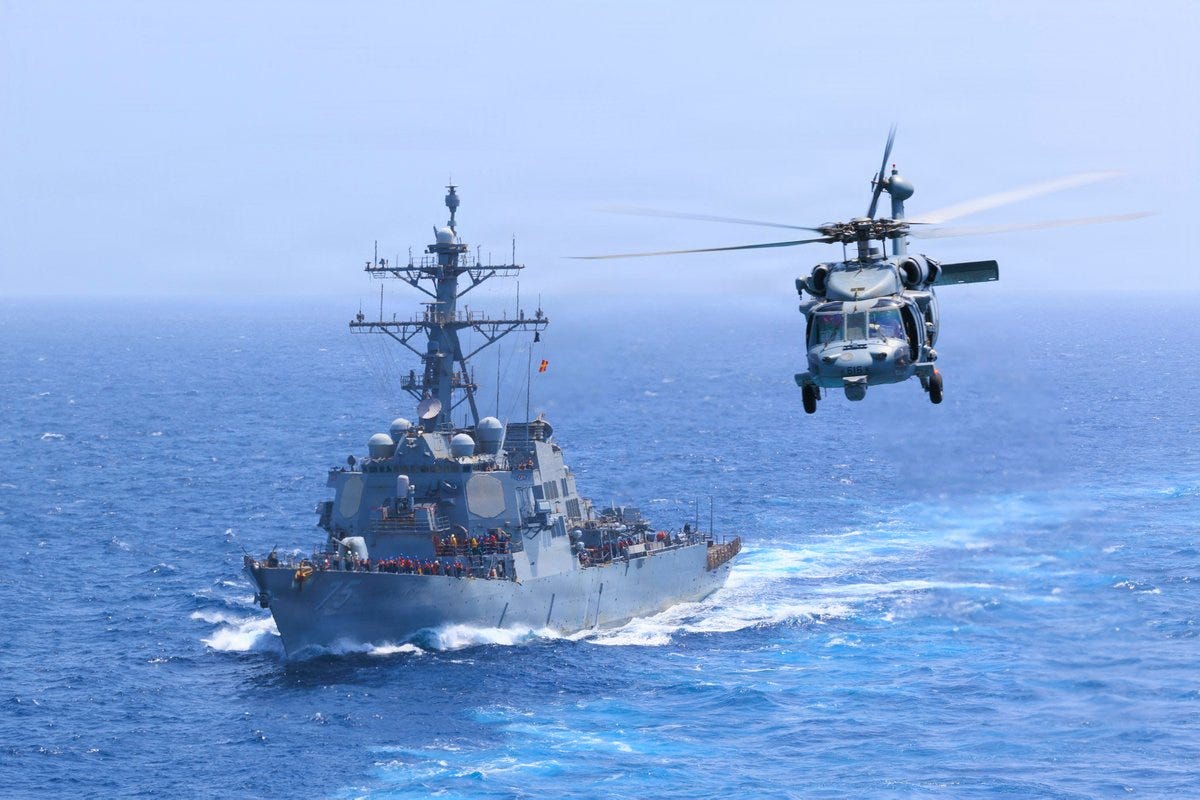
USS Donald Cook transits the Arabian Sea while an MH-60S Sea Hawk flies nearby. (CENTCOM/X)
It’s Sunday, July 19, and as America slid deeper into Vietnam, Lyndon B. Johnson’s adviser George Ball warned: “Once on the tiger’s back, we cannot be sure of picking the place to dismount.” Trump mounted the tiger in February with Operation Epic Fury. The memorandum of understanding was his attempt to dismount slowly. The tiger had other plans.
For now, neither side wants full-scale war. Trump appears to be playing for time until after the midterm elections. Iran, for its part, is content to assert its sovereignty over the Strait of Hormuz and knows that any new round of escalation would deposit its energy infrastructure in the U.S. target bank. Tehran has been happy to walk right up to the line without crossing it.
On Friday, it crossed it—whether by design or miscalculation is still unclear. Two U.S. servicemen were killed in an Iranian missile attack on a U.S. base in Jordan, the first American deaths in the conflict since April. Manned and unmanned aircraft on the ground were also hit, another break from the pattern of recent exchanges. The base has been struck before—an Iranian drone damaged a radar component of the THAAD antimissile system defending it in March, forcing the U.S. to replace it—but until Friday, no one stationed at the base had been killed.
The attack was not just an escalation. It was a show of strength. Iran is adapting to American missile defenses, firing high-speed, maneuverable missiles at U.S. bases across the region. Nor is it adapting alone: U.S. officials believe Beijing and Moscow are enabling Iranian targeting—China through a reconnaissance satellite sold to Iran in 2024, Russia by providing the locations of American warships and aircraft and sharing drone tactics.
Washington has already answered Friday’s attack, striking Iranian coastal surveillance and air defense facilities, maritime capabilities, missile and drone storage sites, and the IRGC unit responsible for the attack. And more is coming: F-16s from Germany are being rushed to the region, with F-35s from England and aerial refueling tankers to keep them all flying close behind. The State Department has issued a travel warning for the region—a smaller signal, but one pointing in the same direction.
It is a bizarre state of affairs: This may be the first time in the region’s history that the entire Middle East is under fire while Israel alone stands untouched. That restraint is itself a signal of Iran’s reluctance to escalate further—to strike Israel now, on top of everything else in motion, would turn the current “ceasefire war” of tit-for-tat exchanges into a war with no modifier.
Meanwhile, whatever Trump’s occasional talk of returning to the table is worth, the U.S.-Iran memorandum of understanding still has no pulse. Supreme Leader Mojtaba Khamenei declared Trump’s signature “invalid,” and Tehran announced it is suspending its commitments, though some regime voices—Parliament Speaker Mohammad Ghalibaf among them—still argue for negotiations. Trump does not seem especially bothered. Asked about Iran’s withdrawal from the deal, he replied: “I couldn’t care less.”
Trump mourned the soldiers, declaring that they were killed in service of “never allowing Iran to have a nuclear weapon.” If that is truly the goal, negotiation is not the way to honor their sacrifice. Iran has given no sign of moderation or compromise on its nuclear program or its control of the Strait.
That said, full-scale war is not necessarily the best means to that goal either. For now, the surest path to keeping Iran from the bomb remains something far less glamorous than either strikes or negotiations: a blockade. Until Iran is starved, Trump cannot safely dismount the tiger.
Israeli security forces near a burned car following a settler attack in the village of Beit Fajjar, south of Bethlehem, October 2025. (Wisam Hashlamoun/Flash90)
I have some bad news for Rep. Ro Khanna: Settler violence is declining. I know—you were hoping to ride your harrowing story of being stopped for anywhere from 20 to 90 minutes, depending on when you tell it, while awaiting IDF clarification, into a presidential campaign. But if current trends hold, the story may be obsolete before the announcement speech, though I’m sure you will recount it regardless.
Settler violence has dropped roughly 25 percent since March 2026, when incidents peaked, according to new data presented to Israel’s leadership on Wednesday. That figure covers attacks that injured people or endangered lives. Factoring in all violent acts, including non-life-threatening ones, the decline is 11 percent.
The drop follows intensified enforcement by the IDF, Shin Bet, and Israel Police. The IDF has signed 23 administrative restriction orders against Israelis tied to the violence in recent weeks—entry bans into Judea and Samaria and, in some cases, house arrest for up to six months. District police have made arrests as well, including six Israelis accused of torching a Palestinian home and four accused of attacking a CNN crew last week, slashing the tires of its vehicle before security forces intervened.
Officials trace the surge to the start of the Iran war in February, calling it “unprecedented.” This kind of violence has historically followed terrorist attacks, not accompanied an Israeli military operation. That timing matters: It suggests a fringe exploiting a moment of national distraction, not a movement rising on its own logic.
The report also sized the problem. Security officials estimate roughly 70 Israelis are the principal organizers, with about 300 more mobilized as followers—mostly anarchist fringe youth who reject rabbinic authority and the state’s own security institutions and who mostly aren’t even residents of Judea and Samaria themselves. Security forces know who these individuals are but have struggled to build evidentiary cases against them—which is precisely why the recent administrative measures, which require no evidentiary threshold, have proven so effective at curbing the violence.
It is worth pausing on the scale involved. Even granting the followers residency for argument’s sake, that is 370 people against a Jewish population in the territory of 500,000—0.074 percent.
Settler violence is morally reprehensible, an international embarrassment, and a stain on Israel’s reputation. But at the most fundamental level, it is something else: a repudiation of the authority of the state and its monopoly on violence. The crackdown cannot let up.
English Editor: Ari Tatarka
If you enjoy the newsletter, you can show your support by becoming a paid subscriber—it really helps keep this going. I’m also offering a special monthly briefing for a small group of premium members. I’d love to have you join us—just click below to find out more.
Thanks for reading It’s Noon in Israel! Subscribe for free to receive new posts and support my work.


Fun factoid: a resident of Chicago has approximately double the risk of being murdered than a Palestine Arab in Judea/Samaria. And whereas a majority of the former are innocent bystanders, the vast majority of the latter are engaging in terrorist activity.
Hey Amit, Dr Shira Efron praised your work during an interview on Ask Haviv Anything!