
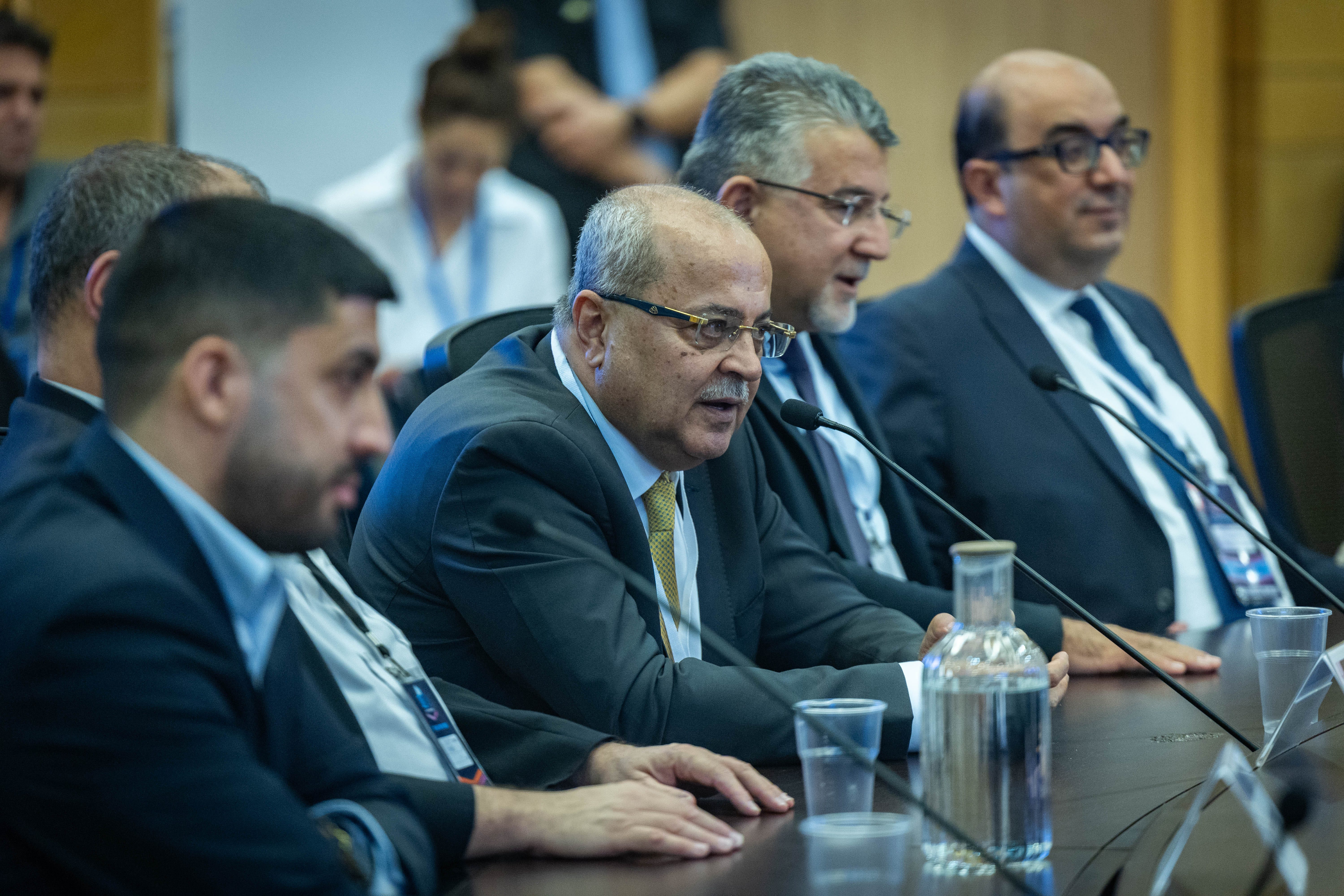
Members of the Joint Arab List Ahmad Tibi, Sami Abu Shehadeh and Yousef Jabareen arrive to submit their party’s candidate list to the Central Elections Committee ahead of the upcoming general elections at the Knesset in Jerusalem, September 8, 2026. (Yonatan Sindel/Flash90)
It’s Tuesday, September 22, and 24 hours after the worst massacre in Israel’s history, with Hamas gunmen still in Israel’s south, a former Knesset member thought it was the right time to declare in writing that the massacre was “an important historic event from a military, political and strategic perspective.” Three years later, Balad chairman Sami Abu Shehadeh wants back into the Knesset.
The law is clear cut. Section 7A of Basic Law: The Knesset bars any candidate whose actions or statements negate Israel’s existence as a Jewish and democratic state, incite racism, or support the armed struggle of an enemy state or terrorist organization against Israel. Otzma Yehudit has petitioned the Central Elections Committee to disqualify Abu Shehadeh on the first and third grounds.
The evidence isn’t exactly conjecture. His column hailed the attack, then drew a lesson from it. Israel and its intelligence services, he wrote, don’t know everything, and “if small and besieged Gaza was able to do this, and at this level, others can do it more effectively and simply.”
Abu Shehadeh knows he can’t spin his words, so he isn’t trying. He’s pleading ignorance, claiming he did not know the extent of the massacre at the time of writing. An impressive feat for any person with a working internet connection, let alone a former member of the country’s parliament.
Even if Shehadeh produces the rock he apparently spent those 24 hours under, he is caught in a trap of his own writing. Was the day historic at 200 dead but not at 1,200? The achievement he credits to “small and besieged Gaza” only grows with the body count.
Nor was the column a lapse. In February 2022, as a sitting MK, he marked the killing of three members of a Nablus cell that had been carrying out shooting attacks on IDF troops by posting their photos with the words “Glory and eternity to the martyrs of our people, the innocent ones.”
The committee will likely bar him. Balad has been disqualified four times, in 2003, 2009, 2019 and 2022, as have two of its MKs, Hanin Zoabi and Heba Yazbak. Every time, the Supreme Court, self-appointed guardian of democratic discourse, put them back on the ballot. The court has only ever chosen to read one of the three clauses, repeatedly citing the ban on racism to disqualify Jewish extremists.
There are two objections worth answering. The first is that democracies should defeat bad ideas at the ballot box rather than keep them off it. That is right for bad ideas. It is not right for applauding a massacre while it is still under way. In one of the best-known rulings on the subject, Aharon Barak offered an example: a party running on a platform of planting a bomb under the prime minister’s car would not be allowed to run. A country, however democratic, does not have to seat someone opposed to its existence, let alone someone who greeted the massacre of its citizens as a historic achievement. The second objection, raised by Abu Shehadeh himself, is that the petition comes from Itamar Ben Gvir, a man once convicted of supporting a terrorist organization. But justice is blind to plaintiff and defendant alike. The case has to be judged on its merits.
The trouble is that the court has always peeked at the defendant. The raison d’être of Balad’s founder, Azmi Bishara, was stripping Israel of its Jewish character. Even when he engaged in his hobby of terror support, praising Hezbollah and, on a visit to Syria, an enemy state, speaking up for “the resistance,” the court protected him. Better, the reasoning went, to keep political enemies inside the tent than drive them toward non-democratic means. Unsurprisingly, no consequences did not incentivize good behavior. In 2007 Bishara left for Qatar under suspicion of passing information to Hezbollah during the Second Lebanon War.
Praising Hezbollah in the early 2000s was a puff of wind next to celebrating October 7. Not even a court blind to the law can salvage Abu Shehadeh. Balad, though, will likely emerge from the blast unscathed. Despite the party’s record of terror support and a platform built on rejecting Israel as a Jewish state, the party remains protected by the court’s blind spot for half of Section 7A.
Its next leader will likely step far more carefully around supporting terror. One cannot help but wonder what moderation might be possible if the court read the clause in its entirety.
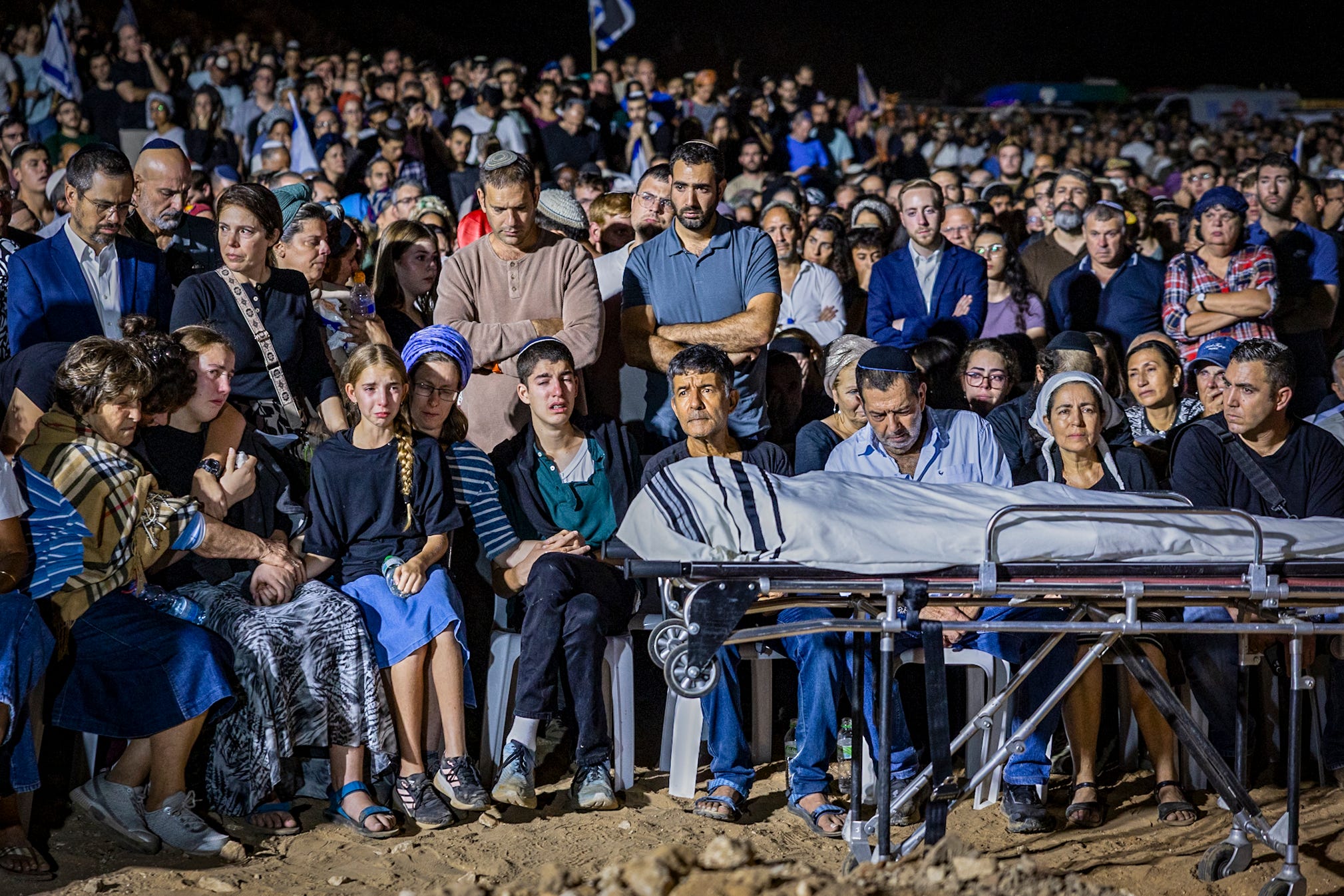
Family and friends attend the funeral of Netanel Shukrun the cemetery in his community of Alei Zahav, September 21, 2026. (Hilel Ben Or/Flash90)
Six hours before the Jewish Day of Atonement, Yom Kippur, Netanel Shukrun, a father of six, was killed when a terrorist opened fire on his car. Netanel used his last seconds of life to tell his son to run. An hour later, a terrorist tried to ram soldiers at a checkpoint. An hour after that, an Israeli who took a wrong turn into a village in the Hebron Hills was attacked and wounded. Forty minutes later, another attempted ramming targeted Israeli troops. Ten minutes after that, a vehicle with no license plates tried to run down two Israelis. Simply another average day in Judea and Samaria.
And people wonder why Israelis tire of the endless accusations of settler violence.
By August 11, the Foreign Ministry had counted 896 Palestinian terror attacks in Judea and Samaria since the start of 2026, with four Israelis murdered and 119 wounded. Over the first half of the year, the security establishment recorded 660 incidents of Jewish nationalist crime, in which six Palestinians were killed and 140 wounded. For the first time, the two columns look almost the same size, but only if you leave out the attacks that would have happened: in 2025 alone, the Shin Bet foiled 1,374 significant attacks, 717 of them shootings and 630 bombings.
Statistics do not justify violence, and this government’s loss of control over the territory is a case of criminal negligence and moral indifference. But for all the talk of how settler violence radicalizes Palestinians, you might expect someone to spare a word for the Palestinian violence that radicalized the settlers.
I do not expect Netanel Shukrun’s name to travel far. No matter how often Israelis point out that Jews in Judea and Samaria are in greater danger than Palestinians, sympathy only flows one way. The international press has settled on a story about the region, and a father murdered on his way home from a swim with his son is not part of it. If the killing is noticed at all, expect a long paragraph on settler violence. The implication, never stated outright, is that people like Netanel brought it on themselves.
So it is worth asking plainly: what did Netanel Shukrun do to deserve death? Was it the swim, or that ancient offense of being a Jew in the wrong place?
The liturgy of Yom Kippur is preoccupied with death. For 25 hours, Jews argue their case before God. They admit to arrogance, stubbornness and baseless hatred, and ask to be absolved and inscribed in the book of life for the coming year. Netanel Shukrun will not get a hearing. In the eyes of the world, he was sealed in the book of death for one unforgivable sin: he lived on the wrong side of the line.
English Editor: Ari Tatarka
If you enjoy the newsletter, you can show your support by becoming a paid subscriber—it really helps keep this going. I’m also offering a special monthly briefing for a small group of premium members. I’d love to have you join us—just click below to find out more.
Thanks for reading It’s Noon in Israel! Subscribe for free to receive new posts and support my work.


I had not yet heard this awful news while sitting in the synagogue, but our Rabbi Itiel Oron knew and referenced the 6 orphaned children. It certainly put us in the right frame of mind to concentrate on the seriousness of the day. And, really for those over "the line," everyday is like a small Yom Kippur. Keep doing what you are doing.
You don’t have to be Jewish to abhor and abominate this kind of attack. You just have to be human and to realize that every time an innocent is murdered for no other reason than being who they are something precious dies with them in every human being.