


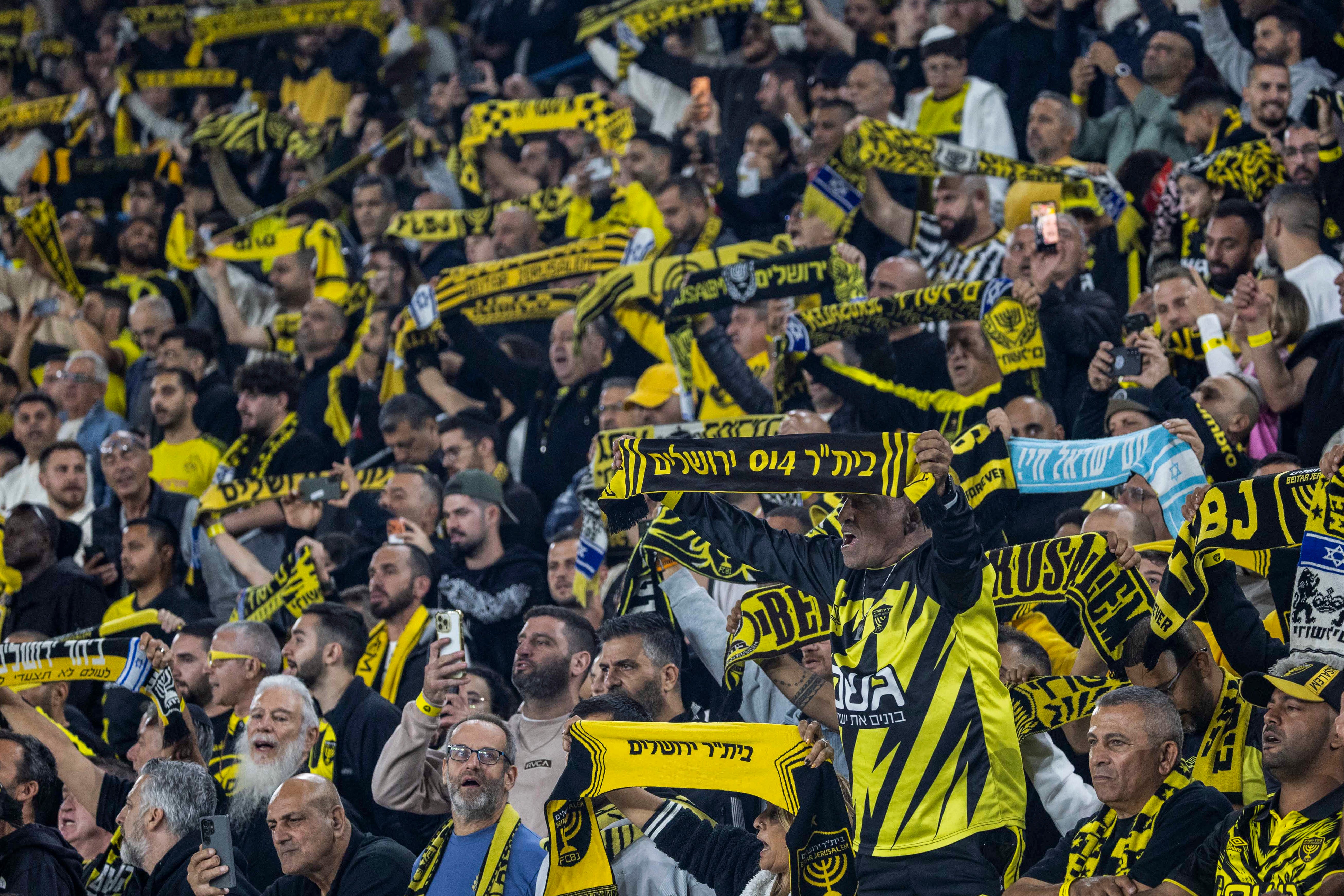
The Israeli Premier League match between Beitar Jerusalem and Maccabi Tel Aviv F.C. at the Teddy Stadium in Jerusalem, October 19, 2026. (Oren Ben Hakoon/Flash90)
It’s Tuesday, October 20, and last night Benjamin Netanyahu skipped the Beitar Jerusalem game. Instead of a roaring welcome from 30,000 potential voters at Teddy Stadium, he flew to Nevatim Air Base in the south to meet U.S. Defense Secretary Pete Hegseth, and, according to Walla, Emirati officials.
The game ended in a goalless draw. The meeting’s outcome is classified, but it’s safe to assume it matters more for Israel’s future than Maccabi Tel Aviv extending its unbeaten streak.
That Netanyahu, a week before an election, gave up a stadium holding roughly three-quarters of a Knesset seat’s worth of voters says how serious it was. Recent waves of attacks show that Tehran is recovering its ability to target ships in the Strait of Hormuz. On one day last week, only seven tankers made it through, under half the weekly average and the lowest since July.
There is also the possibility that Iran is preparing to attack immediately following the Israeli election to sink Republican chances in the midterms.
The visit came a day after President Donald Trump formally endorsed Netanyahu, declaring that without him as prime minister the U.S. would have to go it alone. Whether that was a threat or an observation about the opposition’s mettle remains unclear. A trip by his defense secretary a week before the vote could be either, or not politically connected whatsoever.
The next round with Iran remains murky, but let us hope it ends more conclusively than last night’s game.
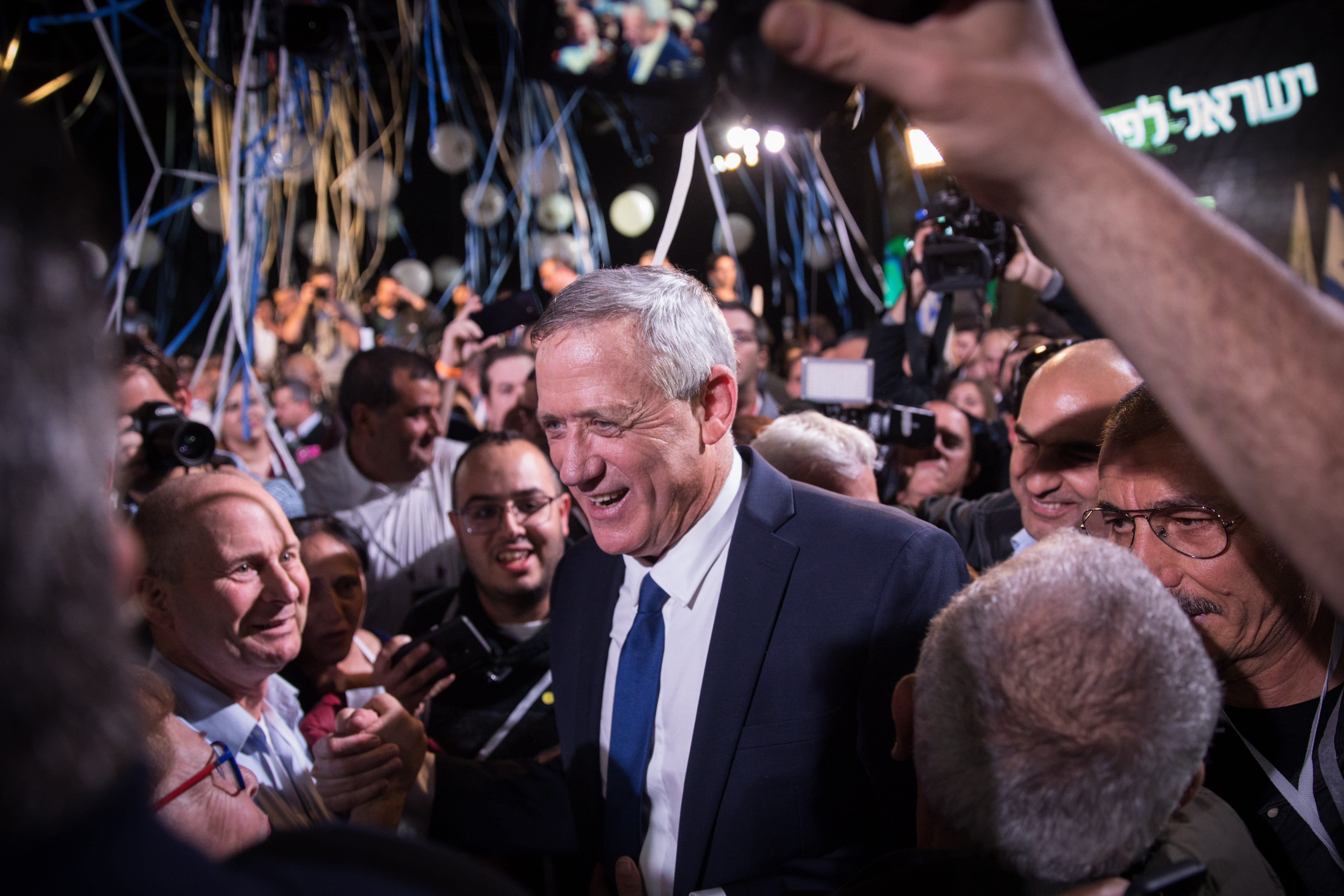
Benny Gantz, Head of the ‘Israel Resilience’ party speaks at the campaign opening event of “Israel Resilience Party” party in Tel Aviv on January 29, 2019. (Hadas Parush/Flash90)
“Gantz’s statements weren’t that different from attacks by opposition leaders like Avi Gabbay, Yair Lapid or Tzipi Livni,” wrote Yossi Verter, Haaretz’s political analyst, when former IDF chief of staff Benny Gantz entered the political arena in 2019. “Yet from Gantz’s mouth they sounded more authentic and raised less ridicule and suspicion. We’ve gotten used to the others, we’ve had enough of some; they are seasoned politicians who have had the chance to disappoint us. Gantz is the new kid on the block.”
Seven years, a Knesset speakership, an alternate premiership, the defense and justice ministries, a deputy premiership and a seat in the war cabinet later, and after leading parties from Blue and White to National Unity and back to Blue and White, the kid became an old man. Having reached retirement age, he has finally thrown in the towel.
Gantz’s path was a well-trodden one. Like many before him, he parachuted into politics from the chief of staff’s office, trading his epaulettes for a Knesset pin. Like another former chief of staff, Shaul Mofaz, he rose to become the leading non-Bibi figure before fading away, preparing the ground for the man who succeeded him in more than just the chief of staff’s office: Gadi Eisenkot.
Tracing Benny’s rise and fall is instructive, if not for Gadi Eisenkot, then for current Chief of Staff Eyal Zamir’s political run a decade or so from now. All the more so because, when he rose to lead the opposition, he was flanked by two other former chiefs of staff, Gabi Ashkenazi and Moshe “Bogie” Ya’alon. Ashkenazi lasted a paltry two and a half years; Bogie an impressive 13, though he never reached Gantz’s stature. Gantz survived for seven, much of it at the top of the ticket.
“The Prince,” as he was known in the army, owed his political survival less to any surplus of charisma than to his talent for repackaging the product: “anyone but Bibi” in 2019, “responsibility” when he joined Netanyahu’s COVID-era rotation government in 2020, “change” when he jumped to the Bennett-Lapid coalition in 2021, “statesmanship” with the National Unity merger in 2022, and wartime solidarity in the war cabinet after October 7. “Unity” was his last label, but after so many changes in packaging, the product had expired.
With each switch, he swapped constituencies, until those still voting Gantz for Benny dwindled below the 3.25 percent threshold. It is a remarkable fall for a man who won more votes than anyone in Israeli politics this millennium second only to one, clearing a million three times. His problem was that most of those votes were cast not for him but against the man who has received the most in Israeli history: Benjamin Netanyahu.
Gantz was simply the latest battering ram thrown against the walls of Likud, his supporters hoping the physically towering general could finally scale the walls and take the government. Yet despite coming closer than anyone to dethroning Netanyahu at the ballot box, he still came up short. In 2019, Gantz was the first since former Kadima leader Tzipi Livni to win more seats than Likud ten years earlier. But like Livni, he learned that more seats do not equal a majority. Sticking to his “never Bibi” pledge, he was stranded at 54 and returned the president’s mandate still in its wrapping.
So when he ultimately joined hands with Bibi during an unprecedented pandemic, in the first rotation government since Shimon Peres and Yitzhak Shamir, much of his electorate reacted the way many reacted to all physical contact in the health panic of 2020: disgust. Every politician from the rival camp who entered a Netanyahu-led government was swiftly obliterated by the court of public opinion, and Gantz was no exception. He became the answer to a trivia question: Who took an oath as prime minister but never served in the role?
The torch passed to the younger yet more experienced Naftali Bennett and Yair Lapid, who took the government before losing it a year later. Yet unlike Netanyahu’s many other defeated foes, Gantz received a second chance. Though his National Unity limped out of the change government’s collapse, it came to embody the sensible middle during the judicial overhaul in 2023, and he rose to face Netanyahu eye to eye in the polls once more.
Then came the decision that, according to some, squandered his second chance at life: after October 7, he entered another unity government with Netanyahu. At first it paid off, and by November 2023 the polls gave him a staggering 43 seats. But when he left in June 2024, he had neither changed the war’s course nor triggered the early elections he hoped for. Instead, the coalition rallied around Netanyahu, who emerged more dependent on Finance Minister Bezalel Smotrich and National Security Minister Itamar Ben-Gvir than before—precisely what Gantz had tried to prevent. The public was unforgiving: some faulted him for not leaving sooner, others for leaving mid-war.
On June 30, 2025, Gadi Eisenkot announced he was leaving National Unity, taking Gantz’s remaining voters with him. Stripped of his title as the leading alternative to Netanyahu, Gantz tried to steer into the skid: Blue and White campaigned for a “national consensus government without extremists,” and Gantz called for breaking the boycott of Netanyahu. But whether voters disliked the product or the salesman, it did nothing to cushion his fall.
And so, 2,853 days after he entered politics, 2,750 days after he tied Bibi at 35 seats, 1,797 days after he was meant to be sworn in as prime minister under the rotation agreement, 1,073 days after he polled at 43 seats, 862 days after he quit the war cabinet and nearly a year since any poll had him clearing the threshold, the general finally surrendered.
So what can Eisenkot’s David learn from Gantz’s Saul? Not simply that Bibi is poison, though Benny Gantz is a poster child for “don’t play with snakes.” Gantz didn’t collapse because he joined Netanyahu’s unity government in 2023. Eisenkot entered that government on the same day, and the two left within hours of one another. That makes it an experiment with a control group: one man can’t clear the threshold, while the other now leads Israel’s largest party. The independent variable is novelty.
Eisenkot is the same basic flavor with a few new mix-ins, which means he comes with the same downsides as Benny Garcia. The generals’ formula is what it has always been: insufficient. Voters, especially soft-right Likud voters, will not march into a different camp simply on a commanding officer’s orders. That was the problem facing Gantz in 2019, and it is the same problem facing Eisenkot today, with a likely outcome to match: another turn in an endless cycle of elections.
The lesson is that Israeli politics lies somewhere between the Bible and “Hamlet”: unity is almost impossible to achieve, and the stage tends to be strewn with bodies. With Gantz’s withdrawal, Eisenkot may fully declare his succession, but “how are the mighty fallen” is a lament best read as a warning.
But in his tumultuous seven-year career, Gantz did more than repeatedly bash his head against an immovable prime minister. He was perhaps the last person in Israel who looked at the chasm between the camps and believed that, at 1.94 meters, he was tall enough to bridge it in one leap. He tried twice and failed, but it was a worthy cause. Gantz’s decision to join the national unity government, together with then-New Hope leader Gideon Sa’ar and Eisenkot, in the wake of October 7 was the right thing for the State of Israel. One can debate what led to its collapse, but the unity shown after the darkest day in the country’s history strengthened the war effort and steadied the public.
As Gantz leaves the political world, we may say he failed to unite a divided country, but he never stopped trying. In an age that rewards the opposite, that is no small epitaph.
Blue and White party chairman Benny Gantz visits in the city of David, in the East Jerusalem Neighborhood of Silwan, January 14, 2020. (Yonatan Sindel/Flash90)
A few election seasons ago, I made a series of short explainers on how Israeli politics actually works. This one, on what Israel’s president does, is my favorite.
English Editor: Ari Tatarka
If you enjoy the newsletter, you can show your support by becoming a paid subscriber—it really helps keep this going. I’m also offering a special monthly briefing for a small group of premium members. I’d love to have you join us—just click below to find out more.
Thanks for reading It’s Noon in Israel! Subscribe for free to receive new posts and support my work.


The visit came a day after President Donald Trump formally endorsed Netanyahu,
In other breaking news...so did I!