Did the Speaker Vote Cross a Line?
Also, the UK imposes further sanctions.
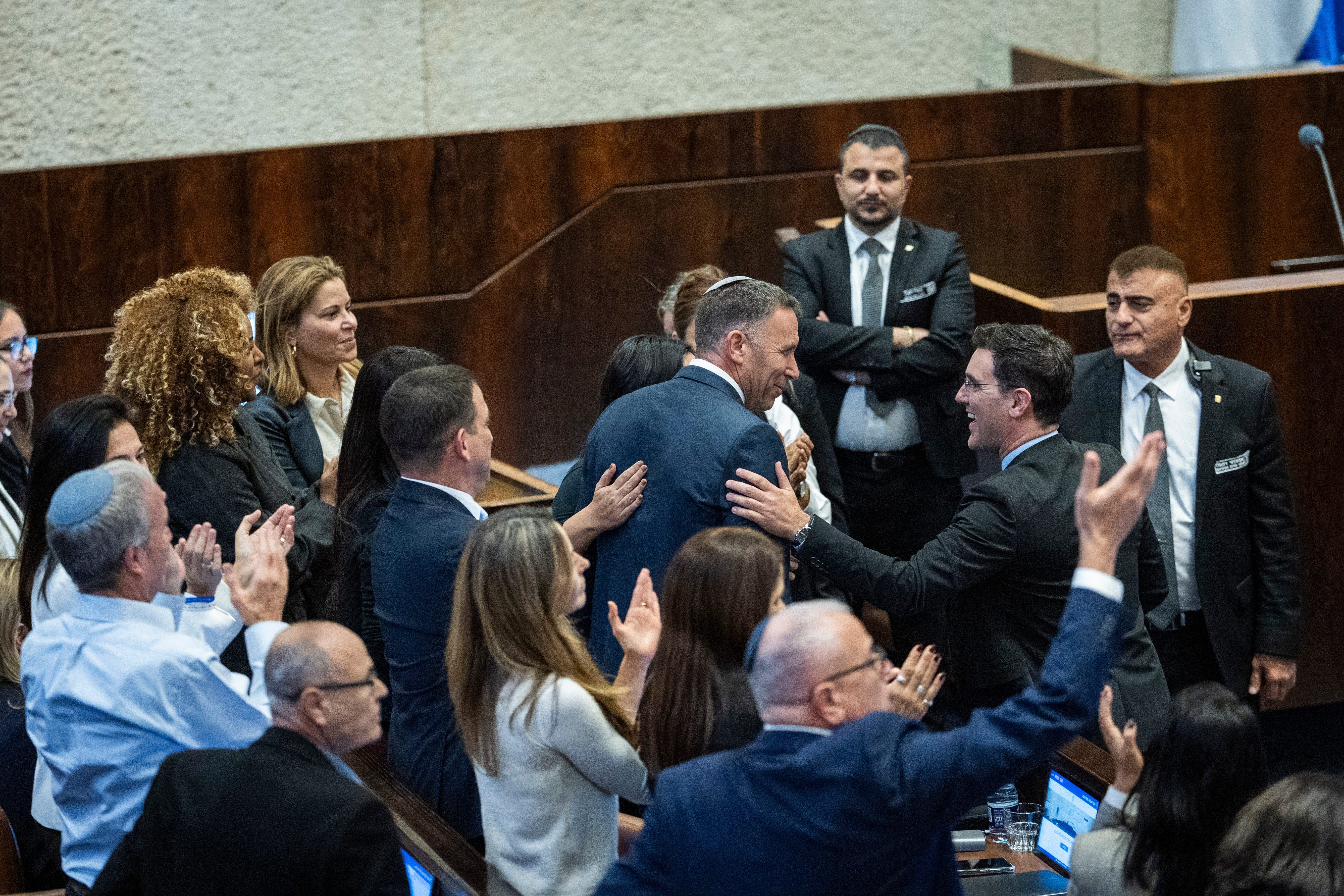
Newly elected Knesset Speaker MK Matan Kahana of the Yashar party is applauded by fellow lawmakers following his election as Speaker of the 26th Knesset, replacing outgoing Speaker Amir Ohana, at the Knesset, the Israeli parliament in Jerusalem, November 17, 2026. (Chaim Goldberg/Flash90)
It’s Wednesday, November 18, and of the 21 people who have held the Knesset Speaker’s gavel, Yashar’s Matan Kahana is the third not to come from the ruling party, the second who identifies as Orthodox, and the first to owe his election to anti-Zionist votes.
Of Kahana’s 66 votes, eight belong to the Islamist Ra’am, which might be considered agnostic on the Jewish state, and 11 to the Joint List, who have never been accused of neutrality.
That raises the question: what may representatives who reject the state’s very basis legitimately take part in?
Until recently, there was a clear consensus: a party that rejected the state’s existence and flirted with, or outright supported, terror was no fit partner for a government. Anti-Zionist parties could be Israeli politics’ mistresses, carrying Oslo and the Gaza disengagement over the line, but never its spouses. It took four elections in two years to change that. Benjamin Netanyahu courted Ra’am leader Mansour Abbas until Bezalel Smotrich objected, leaving Naftali Bennett to elope with him instead.
Now the door has been opened to significantly more questionable partners.
Those clear ideological lines have always blurred in the mundane business of legislation. It has never been taboo for an Arab party to propose a bill, vote or take the podium. Come election season, Zionist politicians take care to draw lines between themselves and their anti-Zionist colleagues. Behind the scenes, the mood has always been more cordial. Ra’am’s Ibrahim Sarsour called for a jihad “to liberate Jerusalem from the hands of the Zionist occupier,” yet still signed his name to more than 300 bills over three Knessets, often alongside Likud colleagues.
There is a clear line between parliamentary participation and governing, and electing a Speaker sits right on it. In theory, the Speaker is an officer of the Knesset, not the government, a non-partisan referee who chairs debates and guards the rights of the House. Given Kahana is only the third not to come from the ruling coalition, it is obviously anything but.
More concerning, last night’s vote looked like a dress rehearsal for a minority government resting on anti-Zionist votes. The right offered Kahana a way out. Religious Zionism promised its support if he didn’t rely on Arab votes, and Likud only fielded a rival once he refused to keep Arab parties out of the deputy speakerships.
Ultimately, the vote split along bloc lines: 66 for Kahana, 52 for Likud’s Ofir Katz. Surprisingly, Katz’s tally included the seven votes of United Torah Judaism, which spent the last two weeks insisting on its neutrality.
With no deal in hand, UTJ was expected to abstain, keeping itself neutral while it negotiated a draft law with Gadi Eisenkot. It was outmaneuvered. At Shas leader Aryeh Deri’s urging, Likud fielded its own candidate, turning the vote into a straight choice between the two blocs. Abstaining would then have looked like helping Kahana win on Joint List votes.
So UTJ backed Katz, but only as far as it had to. It stayed out of the separate ballot on Kahana and abstained on the deputy speakers. This was a tactical step back toward Netanyahu, not a reunion. The message to the more pro-draft Eisenkot: offer us enough on the draft, or we’ll go back to our ex.
Eisenkot has had his rehearsal with the Arab parties. But whether they’ll be waiting for him under the chuppah remains to be seen.
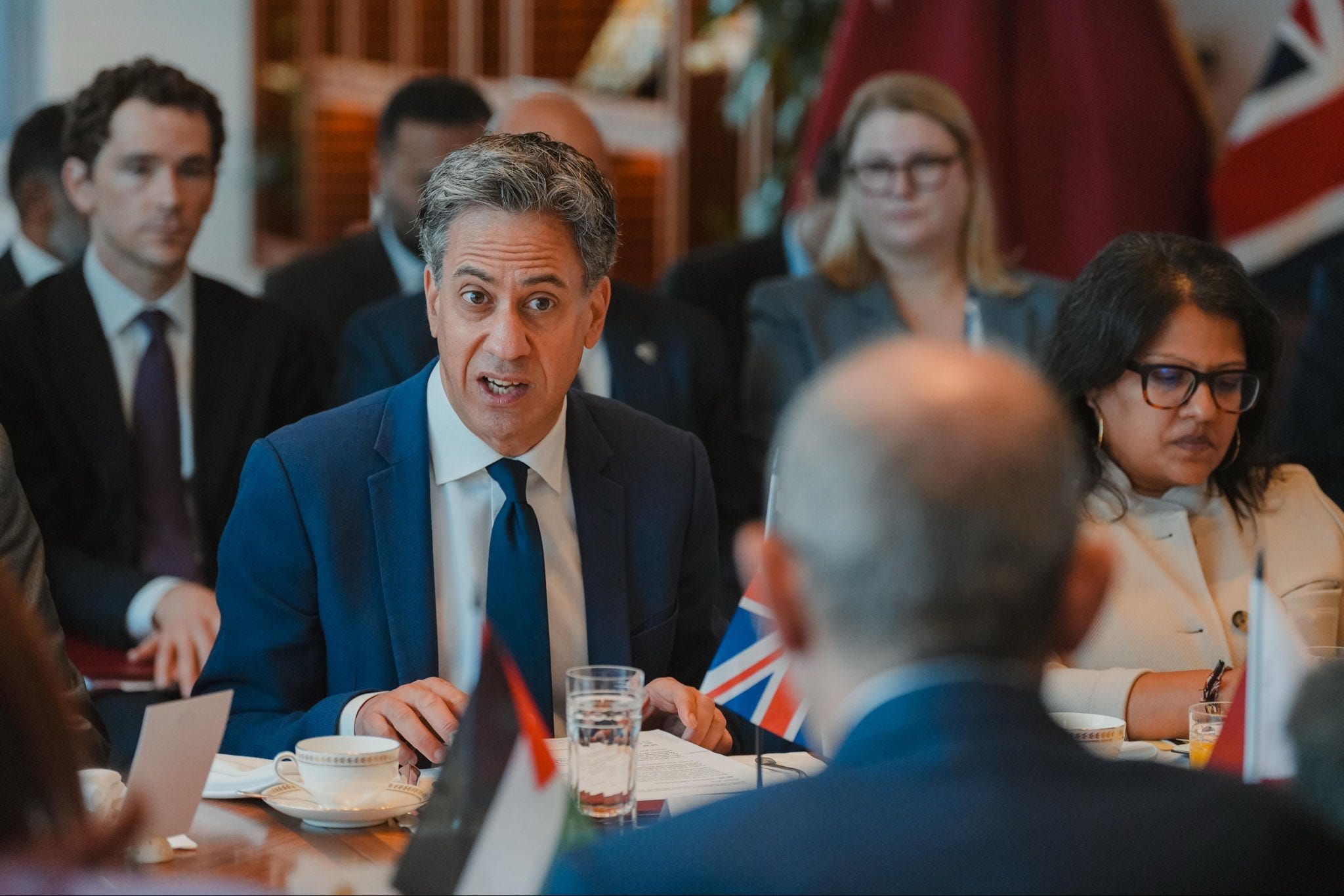
Representatives from the U.K., Jordan and Qatar meet to discuss the humanitarian situation in Gaza. (Ed Miliband/X)
“Do not bid, do not build, and do not profit from the destruction of the two-state solution,” British Foreign Secretary Ed Miliband told Israeli developers on Tuesday. His plea came with sanctions on eight construction firms over the tender for the controversial E1 corridor, a tender none of them bid on, and one Israel’s attorney general froze hours later.
Those hoping Miliband would keep his promise to “judge a new Israeli government by its actions” will note that he hasn’t given one the chance to form.
Then again, he never meant to. Days after the initial sanctions announcement, Middle East Eye reported that Britain would press ahead with sanctions regardless of what Israelis decided at the ballot box. The foreign secretary and self-declared “strong friend of Israel” was reportedly among those fighting off officials who wanted to water the measures down.
Even if Eisenkot forms a government tomorrow, short of making Joint List chairman Yousef Jabareen settlements minister, it appears more sanctions are on their way.
Thankfully, this latest slate is largely symbolic. As the Guardian noted, how far any of the firms depend on British finance “is yet to be tested.” Few such businesses have active projects in Ma’ale Adumim, as well as Manchester. Still, the direction it signals is concerning.
The shoe yet to drop is Miliband’s pledge to go after those who “finance or facilitate” settlements. Virtually every bank in the country lends for construction over the Green Line. If London takes the next step of sanctioning Israeli financial institutions, it will make Dutch customs officers rifling through El Al passengers’ suitcases look like a courtesy check.
Such a move would be all the more damaging because Britain won’t act alone. The Labour government has made Britain the vanguard of the coalition of the sanctimonious, with France and Australia closely following its lead.
One would think Britain’s foreign secretary had more pressing matters this week. The U.S. Air Force has continued its exodus from British bases over Iranian threats, and Iranian state television has named RAF Fairford as a target. Miliband might have done well to heed the chorus of voices from the Foreign Office and, reportedly, MI6, warning that sanctioning Israel would damage intelligence sharing and British security, rather than the clamor from the Gaza independents.
Before sanctioning Israeli architects, he might have pushed his government to finally proscribe the IRGC. Then again, I suspect the former plays better in certain constituencies.
English Editor: Ari Tatarka
If you enjoy the newsletter, you can show your support by becoming a paid subscriber—it really helps keep this going. I’m also offering a special monthly briefing for a small group of premium members. I’d love to have you join us—just click below to find out more.
Thanks for reading It’s Noon in Israel! Subscribe for free to receive new posts and support my work.


Israel conducted an experiment of the two-state solution. The experiment ended on Oct. 7 2023
I really hope that Israel stops giving Britain intelligence. Let them get blown to high hell. Inshallah.