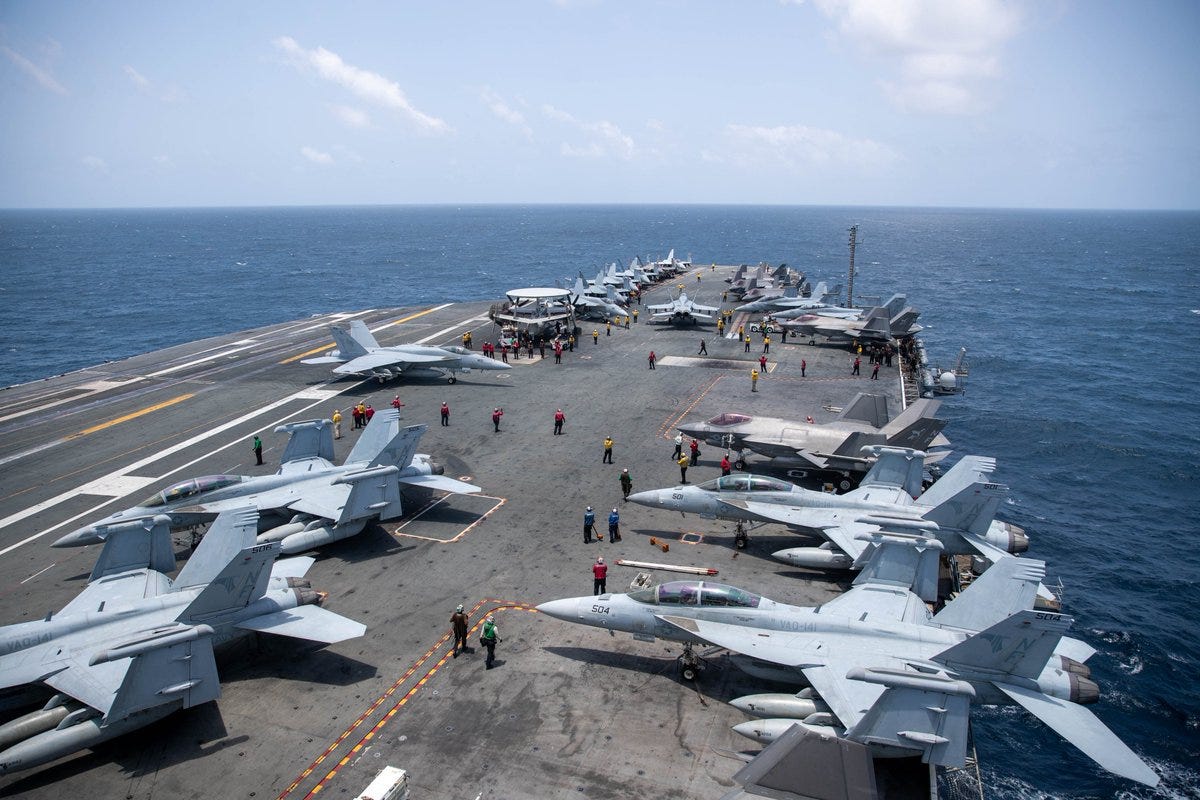
U.S. Sailors work on the flight deck of USS George Washington, August 20, as the aircraft carrier transits the Arabian Sea. (CENTCOM/X)
It’s Sunday, August 23, and in the legendary X Article, also known as “The Sources of Soviet Conduct”—American diplomat George Kennan laid out an audacious thesis: “Who can say with assurance that the strong light still cast by the Kremlin on the dissatisfied peoples of the Western world is not the powerful afterglow of a constellation which is in actuality on the wane?” In other words, the terrifying power that had just drawn an Iron Curtain across Europe was in fact a paper tiger. What if Iran is the same way—weaker than anyone thought, its post-war signs of stability in fact masking a steadily cracking foundation?
Many read the 13 days of U.S. strikes on Iran in late July as loud, inconclusive and ultimately swallowed by another round of deal rumors. Channel 14’s Tamir Morag reads them differently. The absence of strikes on the high-value sites deep inside Iran wasn’t hesitation—it was a choice to spend the campaign dismantling the radars and sensors that let Iran control the strait.
The conventional wisdom dictated that since a single IRGC survivor with one remaining drone is sufficient to make global shipping sailing the opposite direction, nothing short of convoys, and perhaps not even that, could reopen the strait. But a blind attacker is almost as harmless as a disarmed one, so CENTCOM went after the network of radars, cameras and sensors.
The radars went first. Iran had meant to protect them with mobility—a radar truck rolls out, paints the strait for a few minutes, finds a tanker, and folds back into hiding. The trouble is that a radar, the moment it switches on, becomes the most conspicuous thing over the water, and a missile rides its own beam back to the truck.
The cameras were the harder half. Electro-optical and infrared sensors don’t emit “kill me” signals, and the islands in the strait lent the Iranians a perch from which they could track a tanker without announcing themselves. According to Morag, there was no shortcut against passive sensors, only the slow work of finding them by eye and taking them out one at a time, until the whole network, radars included, was significantly degraded.
Despite being blinded, the regime is still selling the myth of control because the strait constitutes most of its leverage at the negotiating table. A press that wanted the story to be one of Trump’s failure is still running with the Iranian line.
Meanwhile, Washington has renewed much of the traffic. Convoys are running the southern lane along the Omani coast at night with transponders off—dark enough that Iran struggled to find them, and dark enough that civilian trackers missed them as well, leaving open-source intelligence observers to conclude that Iran’s dominance remained complete. At the same time, Washington began guaranteeing the ships against their new insurance costs and worked the captains one call at a time to run the newly protected strait.
All this work culminated in Energy Secretary Chris Wright’s announcement last week that the seven-day average of oil leaving Hormuz had risen to 9 million barrels per day—and about 15 million total when the bypass pipelines and export facilities are added in, against roughly 20 million before the war. Morag puts the total at 10 to 13 million.
The pre- and post-war gap is significant, but with the U.S. and Venezuela ramping up production and China, the second-largest consumer of oil, still restraining its consumption, something more than Trump’s Truth Social account has been keeping oil prices below $100.
Hormuz, of course, carries larger implications than the immediate price of oil. If Iran loses its grip on its “nuclear weapon,” as Rahm Emanuel described it to me, while still under blockade, its leverage is significantly reduced.
Today, Treasury Secretary Scott Bessent is expected to announce the opening salvo against any country that provides “any type of lifeline to Iran” as part of Trump’s newly declared economic war. According to the secretary, the sanctions will “collapse this regime”—perhaps overly ambitious, but I’m glad to see regime change set as a goal, even if only in an economic capacity.
But as George Kennan said of the Soviet Union, “it cannot be easily defeated or discouraged by a single victory on the part of its opponents.” It will take “patient persistence” to bring down the enemy.
Forty-four years passed from the writing of his article to the collapse of the Soviet Union. If Trump can show the same moral and institutional persistence against Iran as the best-remembered of U.S. presidents did against the Soviet Union, I highly doubt it will take that long.
View of a fire near Kibbutz Be'eri, caused from kites flown by Palestinians, near the border with the Gaza Strip, August 13, 2020. (Yonatan Sindel/Flash90)
It began, as such things do, with something that appeared insignificant. In the spring of 2018, kites drifted across the Gaza fence into Israel, and where they landed, fires erupted. Then came the balloons—party-colored, helium-filled, trailing burning rags and, before long, small charges—carried deeper inland on the wind. They cost almost nothing and were often flown by children, making the IDF reluctant to fire at the aggressors. By July 2018, 678 fires had burned 910 hectares (2,260 acres) of woodland and 610 hectares (1,500 acres) of agricultural land.
The practice never really ended, waxing and waning over the next few years, Hamas slowly pushing the envelope as it launched them closer and closer to the security fence until they breached it on October 7.
So one can imagine the fear sparked when, over the weekend, several kites drifted across the fence from Gaza and landed in the fields around the still-recovering Kibbutz Nahal Oz. The IDF checked them and reported that nothing suspicious was attached to the toys, though that was hardly comforting to the thoroughly traumatized residents of the envelope.
The kites carried Arabic messages instead of explosives. One, by Ynet’s account, amounted to a promise never to rest. Some trailed strings 2 to 4 kilometers long—too long, the security establishment suspects, to be about flying a kite. The current guesses are intelligence-gathering or a dry run for fiber-optic drones, the weapon used to such great effect by Hezbollah in southern Lebanon.
A kite with no charge seems benign. Eight years and 1,200 dead after the first kites flew over, we know it is malignant. “After October 7,” said Uri Epstein, who heads the local regional council, “we will not again accept the words ‘it’ll be okay.’”
English Editor: Ari Tatarka
If you enjoy the newsletter, you can show your support by becoming a paid subscriber—it really helps keep this going. I’m also offering a special monthly briefing for a small group of premium members. I’d love to have you join us—just click below to find out more.
Thanks for reading It’s Noon in Israel! Subscribe for free to receive new posts and support my work.


You had me up until Rahm Emanuel - then article lost all credibility. If Rahm Emanuel is your source…