


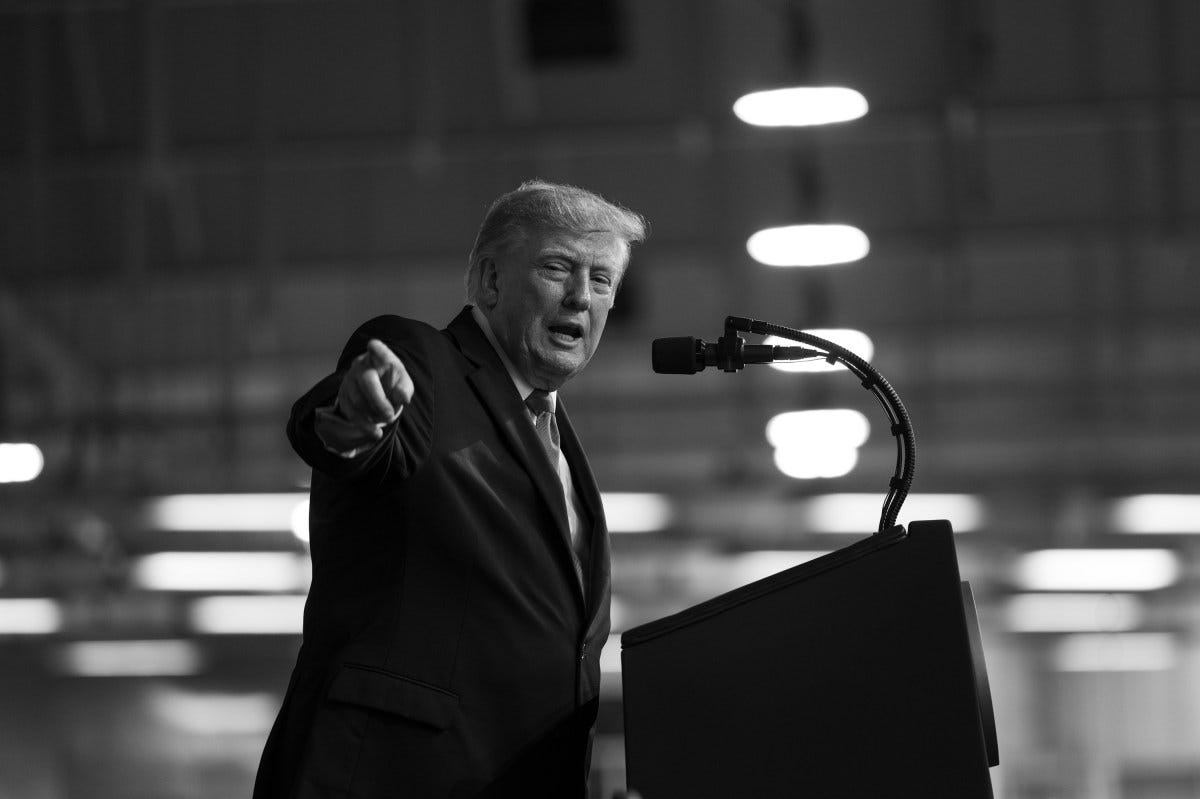
Donald Trump delivers remarks at the Peterbilt Motors Company in Denton, Texas. (White House)
It’s Monday, October 19, and Donald Trump and Benjamin Netanyahu are up to their old tricks: keeping their distance in public while preparing a dramatic move behind closed doors. The element of surprise was maintained; only this time, the victim isn’t the Iranian regime. It’s the Israeli opposition.
Last night, in a statement that left even the media no room to find daylight, Trump gave Netanyahu his “Complete and Total Endorsement.” The Prime Minister’s Office insists it was spontaneous and unprompted. I suspect it was anything but. Either Trump has excellent intuition, or someone briefed him on the central message of the Likud campaign: “Netanyahu has been a Great Warrior Prime Minister, and an even greater Partner for Peace in combatting the Islamic Republic of Iran,” and, most of all, if Israel has “the wrong Leader, which would be anyone other than Bibi,” the U.S. would re-enter Iran alone.
Why now?
Contrary to what Tucker Carlson will likely say, the endorsement was not the work of some duplicitous Jew—I mean, Israeli agent—in Trump’s cabinet. Among Trump’s advisers, including those who happen to be Jewish, few would vote Likud. They likely told Trump to wait out the election, crossing their fingers for a government more receptive to American plans, only to be blindsided by a sudden outpouring of goodwill from the president.
Despite the risk inherent in trying to read Trump, it is worth speculating what brought about his generous campaign contribution.
Trump’s favorite people are winners and people who look good on TV; Netanyahu has remained the latter, but his status as the former has been called into question.
The endorsement can be read as a vote of confidence from a super, if not higher, power. The White House runs its own polls in Israel, and presumably they look closer to Channel 14’s coalition majority than to Channel 13’s ignominious defeat. Yet according to a White House source, there are no new polls. The administration’s numbers supposedly show what most surveys have been pointing to: neither bloc has a majority.
That doesn’t help Netanyahu. But it doesn’t help Gadi Eisenkot either.
Rather than positive polling, the endorsement may be the result of a simple fact: when you’re president of the world’s greatest superpower, endorsing the wrong candidate costs nothing. In Hungary, Trump campaigned hard for Viktor Orbán, yet Péter Magyar, has refrained from retaliating. If invited, the new Hungarian prime minister will arrive at the White House beaming; any mentions of Orbán will be met with a polite change of topic and thanks for Trump’s previous support. Even if Trump starts attacking Bibi’s competitors by name, assuming he remembers them, upon taking office Eisenkot, Avigdor Liberman, or Naftali Bennett will smile and thank the president for his support of the State of Israel.
Israel’s position is not so different from Ukraine’s. Even if Trump starts buying Iranian oil in November, Eisenkot, like Ukrainian President Zelensky, will keep his tone polite and deferential.
If this episode teaches anything, it is that, like Mark Twain’s death, the reports of daylight between Trump and Netanyahu are greatly exaggerated. The difference is that the media only announced Twain’s death once before they learned their lesson.
When it comes to Trump and Netanyahu, there is always more to the relationship than what makes it into print. Here, the “more” is the subject the endorsement kept returning to: Iran.
It appears that after vanquishing Israel’s opposition, Trump and Netanyahu plan to move on to what is left of the Islamic Republic. If plans have already been set, it is understandable why Trump would want the leader already briefed to remain at the helm.
Whether Trump’s claim that without Netanyahu “America will have to do this work ourselves” is a threat or an observation is an open question. If Trump is demanding Netanyahu as a precondition, that doesn’t mean he is voting for the coalition, only for a government with Netanyahu.
America doing the job alone is threatening Europe with a good time but would spell disaster for Israel. If the U.S. is returning to Iranian skies, likely for the last time, Israel needs to get its punches in before the window closes. “Unity” may be a dirty word in the opposition today, but we will see how the term evolves if Trump adds Iran into the equation.
The truth is, unity is likely the only way Bibi remains at the head of a stable coalition. Trump would be angry to find out that his name alone is insufficient to net Bibi another five or six seats. That reflects the dive in both Trump’s and Bibi’s popularity, and the difficulty of convincing what even Moses called a “stiff necked people.”
Large billboards near Ayalon highway in Tel Aviv, showing support for Israeli PM Benjamin Netanyahu and US President Trump, April 13, 2026. (Miriam Alster/FLASH90)
Had Trump run for office in Israel in April 2026, he may very well have won the first parliamentary majority in Israeli political history. His domestic popularity never recovered from Liberation Day. Israelis didn’t stop loving him after the 17 percent tariff and kept loving him when he called an early end to the war. Seventy-three percent rated him an above-average president. Then he signed the MOU. By July, only 7 percent trusted him a great deal. Forty-five percent didn’t trust him at all.
Meanwhile, Netanyahu has been floating between 30 and 40 percent since 2024. The three things Israelis are most sure of are their names, their birthdays and their opinion of Benjamin Netanyahu, and all three are about equally likely to change due to a recommendation from Trump. Even assuming no overlap between their constituencies, Trump’s 7 percent plus Netanyahu’s 40 does not equal 61.
That is why Netanyahu is trying to win legs rather than hearts and minds. Turnout can give him the inches he needs to prevent a stable coalition without him, and that is where Trump’s endorsement may come to the rescue. Despite the distance, Israel is not immune to the power of Truth Social. A few words from the president push everything else off the front page, and they turn the question in the campaign’s last week from who will draft the Haredim into who will finish off Iran.
Netanyahu knows better than anyone that a candidate can beat a presidential endorsement, as long as he controls the conversation. Bill Clinton all but went door to door for Shimon Peres in 1996, yet when Israelis went to the polls that May, they were asking who was likely to divide Jerusalem, not who would work best with the president. Eisenkot may yet get a Clinton-like call from Trump on October 28, conceding that, despite Trump’s best efforts to “screw him,” he prevailed. But that call will only come if Eisenkot can regain control the conversation.
That now looks like a herculean task. Eight days before the election, Trump has reframed the campaign. Until now, Likud has run on the threat of a government propped up by the Arab parties, specifically with the slogan referencing Ta’al chairman Ahmed Tibi. The question is whether Israelis will vote differently now that the choice is no longer Bibi or Tibi, but Bibi or Khamenei.
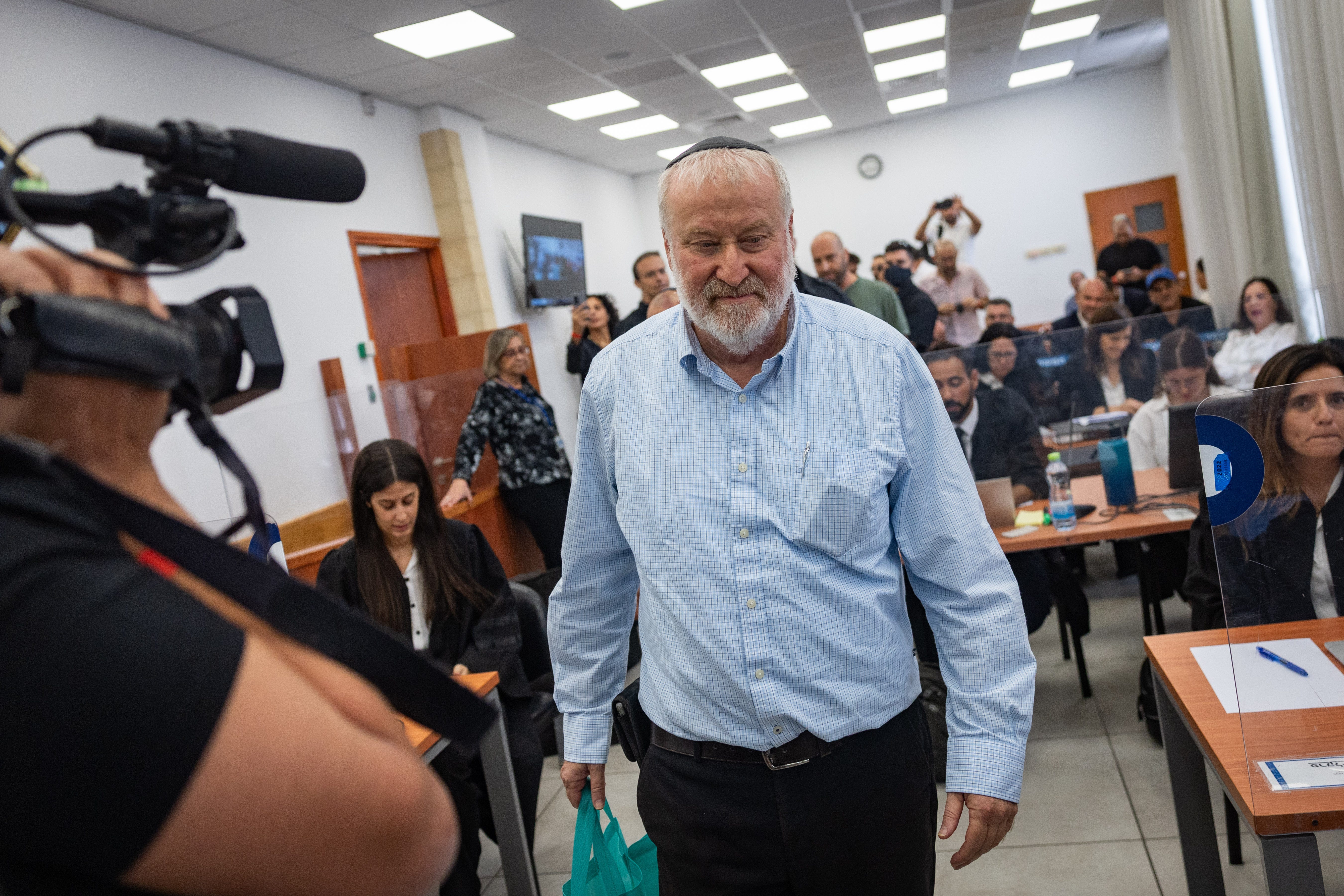
Former Israeli Attorney General Avichai Mandelblit arrives to testify in the corruption trial of Prime Minister Benjamin Netanyahu at the Jerusalem District Court, October 11, 2026. (Chaim Goldberg/Flash90)
Many suspects make a habit of wearing a kippah in the courtroom, to look humble and sincere. Avichai Mandelblit, the former attorney general, is not a suspect in the criminal sense, and he does wear a kippah, but he arrived at the District Court carrying a plastic bag. The bag plays the same role as the kippah. It says, “I’m not as sophisticated and malicious as you think.” The sophisticated schemer’s house of cards is all fancy leather briefcases; I’m just poor Avichai from Petah Tikva, with a nylon bag.
What would Attorney General Mandelblit have said about such a central figure who, by his own account, didn’t know, didn’t hear and didn’t see what was happening beneath him, and in the flagship event of his tenure no less: the first criminal trial in the state’s history of a sitting prime minister? By his own account, Mandelblit didn’t know about the dark, criminal investigative ploy against Nir Hefetz, a former Netanyahu media adviser. Senior prosecutors approved it, and he found out only after the fact. He didn’t hear about the attempt to recruit Shlomo Filber, the former Communications Ministry director-general, as a state’s witness. “That is not acceptable to me,” he added afterward. He didn’t see even one of the 315 supposedly positive articles on Walla that form the core of the indictment, the alleged bribe for which he imposed on Israel a nine-year hurricane that is still raging, wrecking every good plot.
Either Mandelblit lied on the witness stand, or he lied at the podium at the Justice Ministry. On the day he decided to issue the notice of suspicions against Netanyahu, he declared: “In recent months, the most senior teams of first-rate prosecutors, headed by the State Attorney and the Tel Aviv District Attorney, have turned over every stone and examined every piece of information. We held dozens of lengthy and thorough discussions. I heard all the opinions, all the arguments and all the angles. We did not hurry, did not cut procedures short, and acted without fear or favor, with one single purpose: to get to the truth.”
How does that speech square with the fact that the attorney general indicted without examining a single article? Never mind that. How can anyone claim he acted “professionally and transparently, out of an uncompromising commitment to justice and the rule of law in the State of Israel,” when this week he himself discovered on the witness stand that Netanyahu was never confronted with even one Walla article? How do you bring a groundbreaking charge of biased coverage without checking, say, that the articles were also published by other media outlets? “If what you’re saying is true, then I wasn’t told,” the man with the bag played dumb. “Should they have told me? Of course. What, to mislead me?”
This lack of awareness was not born in a vacuum. It bears repeating: the public service in the State of Israel is mediocre and failing. What you see at the land registry is what you see at the Justice Ministry. Those who say there were also serious failures in the Olmert trial are right. Well, and what exactly does that prove?
But mediocrity turns lethal when it is poured into one cocktail with ruthlessness and politicization. Roni Alsheikh, the police commissioner at the time, has already confessed that no one thought Netanyahu would remain in office. Last week it emerged at the trial that senior investigator Yoav Talem broke every rule in questioning Ilan Yeshua, the former Walla CEO, when he told his subordinates, “This won’t reach trial.” A system with a 98 percent conviction rate, which enjoys a presumption of propriety and can delay investigations or rush them according to interest, is exactly the kind that would go out to the greatest campaign in its history with empty emergency depots, no training and in radio silence, because the enemy is deterred and will surrender anyway. It’s called the conceptzia.
This episode, incidentally, underscores two conclusions. The first is how essential it is to pass the law that would separate the Police Investigations Department from the Justice Ministry. The trial revealed that the senior prosecutor who approved the criminal ploy against Hefetz is the same one who discussed how to bury the investigation into it. The second is how abhorrent and immoral the Defendant Law is, the bill that would bar anyone under indictment from forming a government. No one should have the power to thwart the choice of millions, especially people whose bag of dirty tricks turns out to be, in this case, plastic.
This is an excerpt from my weekly column in Israel Hayom.
English Editor: Ari Tatarka
If you enjoy the newsletter, you can show your support by becoming a paid subscriber—it really helps keep this going. I’m also offering a special monthly briefing for a small group of premium members. I’d love to have you join us—just click below to find out more.
Thanks for reading It’s Noon in Israel! Subscribe for free to receive new posts and support my work.


It was HaShem, not Moshe, who called the Jewish people “stiffnecked.” (Ex 32:9)