
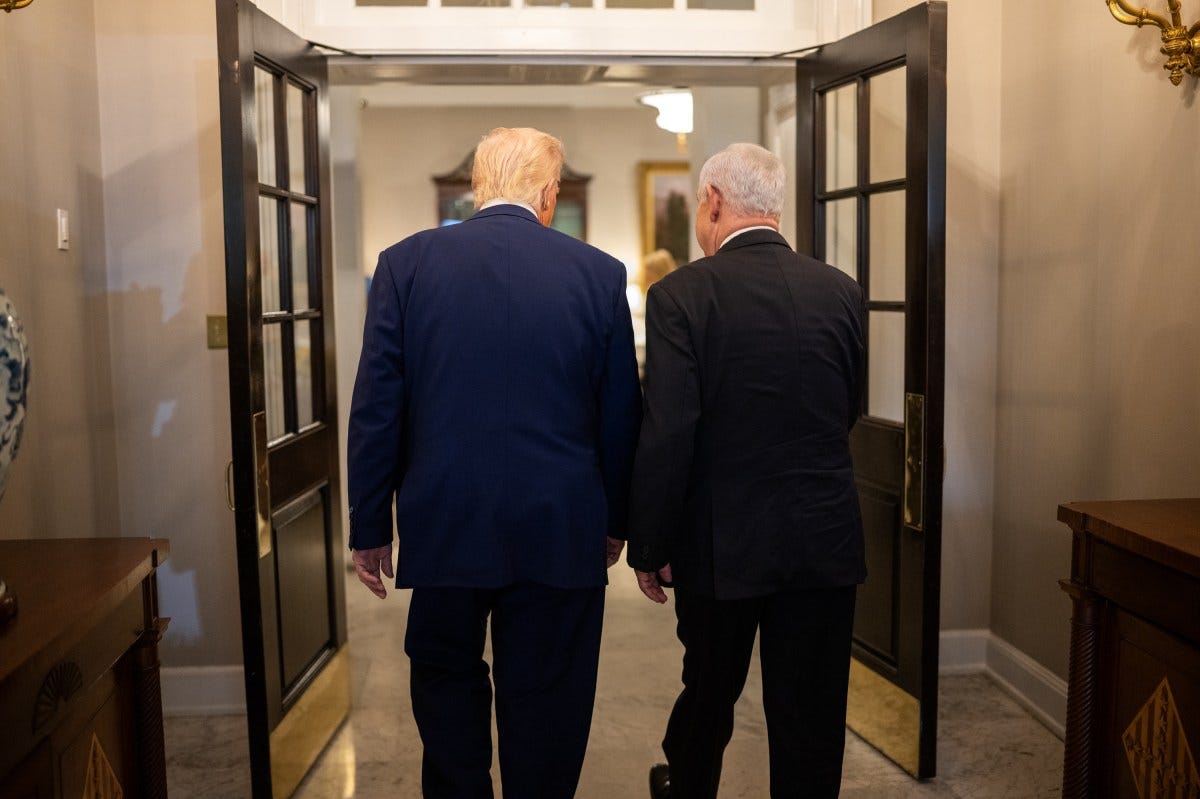
Donald Trump greets Benjamin Netanyahu at the White House, 2025. (White House)
It’s Friday, October 9, and on January 20, 2029, in the early evening, a new occupant will sit down in the Oval Office at the White House. In front of the cameras, following the tradition of the last decade, he’ll sign a long string of executive orders that will instantly and sharply alter the course of the great American ship of state. If he’s a Democrat—and the odds of that now stand at 50 percent at least—among the stack of papers his aides hand him will likely be recognition of a Palestinian state, a ban on importing goods from the settlements, sanctions on a string of right-wing Israeli politicians, and more still to come.
It’s remarkable how little connection there is between the shabby, substance-free election campaign that’s been running here these past months and the real issue of the next term: the head-on collision approaching between Israel and the world over the Palestinian question. This is the diabolical legacy of the tormentor Yahya Sinwar, who in dying bequeathed the return of this issue to the center of the international table, at the exact moment Israel has run out of supporters for establishing a hostile Islamist terror state next to the central city of Kfar Saba—given the bitter experience of Kfar Aza.
The only one who has proposed anything along these lines is Avigdor Liberman, the Yisrael Beiteinu leader. His plan to bring Jordanian forces into the territories of Judea and Samaria is, in my view, a bitter mistake and a terrible error, but at least he understands that Israel has to seize the initiative rather than keep sailing calmly toward the iceberg. Gadi Eisenkot, the Yashar leader, swings back and forth between visiting Gush Etzion and reversing the moves of Bezalel Smotrich, the Religious Zionism leader, in the West Bank; the coalition’s answer is to stick with the current course—another dunam, another goat—in the hope that the world will get used to it.
“This isn’t a foregone conclusion,” a source who knows a thing or two about U.S.-Israel relations tells me. “Even a hostile Democratic administration won’t rush to drop the automatic veto at the Security Council or recognize a state if we’re on a stable, positive track.” He, for instance, laments the scrapping of the annexation clause in Trump’s Deal of the Century, whose absence has let settlement efforts sprawl across the whole territory instead of gaining legitimacy for applying sovereignty.
But looking ahead, he says, the real story is Gaza. That’s where everything started, and that’s where everything will be decided. The Trump plan that ended the war is a significant achievement worth holding onto, because it’s the first one that tries to decouple the territory between the Jordan and the sea from the Oslo framework. Judea and Samaria and Gaza are no longer linked, the PA is being replaced by a different governing arrangement, the 1967 lines are being swapped out for an Israeli presence in the Strip, and above all, the UN is being pushed aside in favor of the Board of Peace. A Gaza that is rehabilitated, demilitarized, run by neither the PA nor Hamas, could be exactly what stops the world from trying the same mistake it made in the West Bank in the 1990s, hoping for a different result this time. The first clause in the Trump plan includes something Oslo and its offshoots never did: de-radicalization. Israel will always have that stick to wave against any rollback, and the world can’t object to it.
The problem is that everything is stuck. The Americans are frustrated to the point of alarm with how Israel is conducting itself in the Strip, but the truth is they couldn’t have picked a worse moment to launch their plan: right on October 27, 2026, at the start of an election year. Two months passed before all the hostages’ bodies were returned, then came Operation Lion’s Roar in Iran, and by then the campaign at home was already heating up. A senior Israeli official drummed it into the ears of Jared Kushner, President Donald Trump’s son-in-law: if you want the plan to die immediately, the surest way is to push for it right now. The right will kill it, and Netanyahu will have no choice. And the opposition? the Americans asked. They’ll make sure it’s dead too, he told them. Netanyahu, after all, is being attacked these days almost entirely for being too dovish, not too hawkish.
That’s why the question of the next government’s makeup carries enormous weight. A unity government, freed from day-to-day survival struggles and including most of the parties, could make real decisions on Gaza. Incidentally, footage of surrendered Hamas weapons and demolished tunnels probably isn’t bad for a government, even if it’s not all the weapons and all the tunnels. A pilot could start in a cleared-out Rafah, then Khan Younis, then we’ll see. Israel has, in all likelihood, two final years with a great friend in the White House, and it’s up to Israel whether to use them to establish facts on the ground, or to squander them on one election after another after another.
This is an excerpt from my weekly column in Israel Hayom.
Shimon Peres once quipped that polls are like perfume—to be sniffed, not swallowed. It’s good advice, but Israeli politicians now face a cacophony of scents, some sweet, some foul, and the question is which ones to sniff at all before anyone dares raise one to their lips.
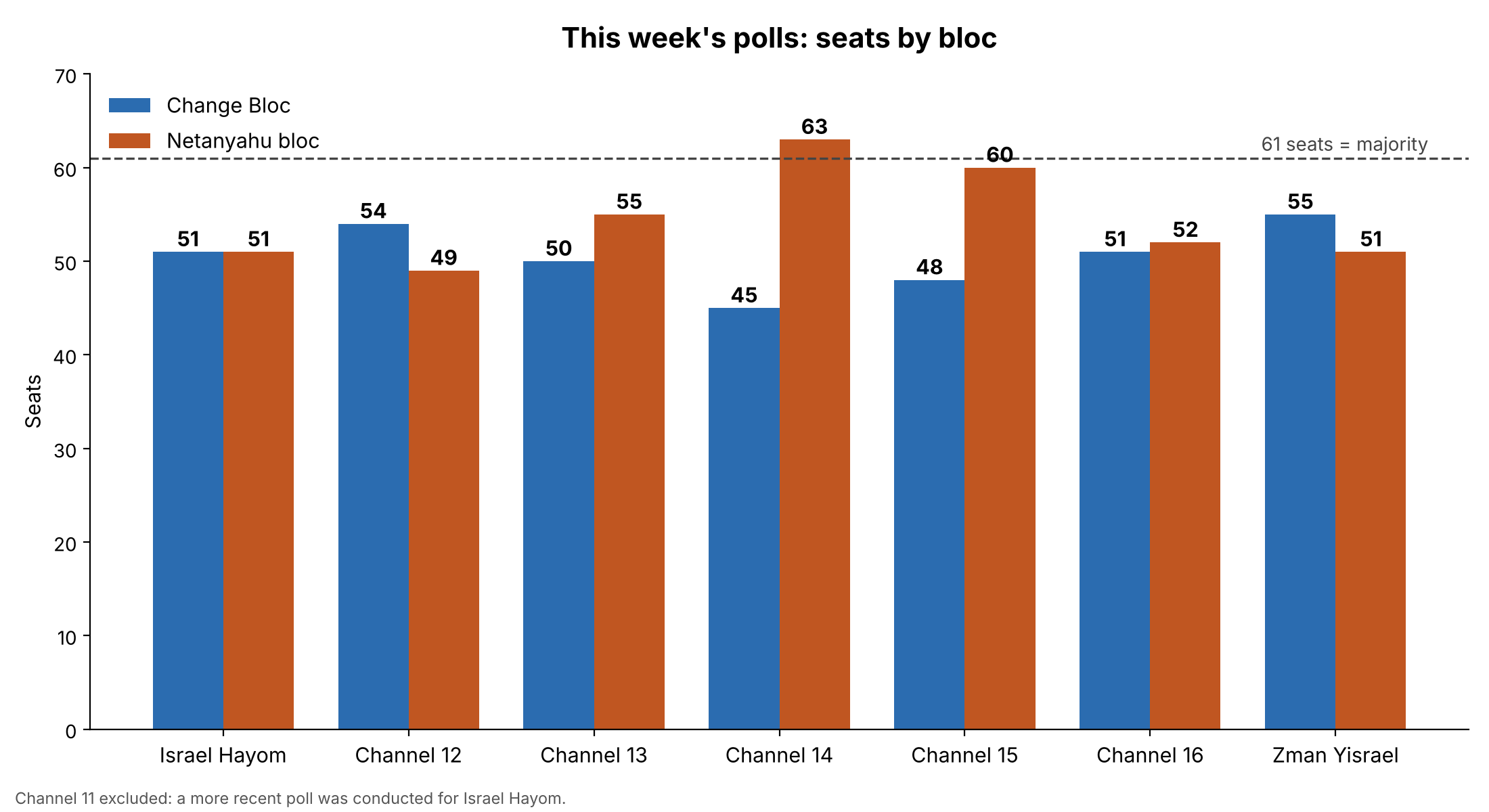
While the opposition leaders met to coordinate positions and project unity, a no-less significant, no-less dramatic meeting was convening on the other side. The top of the Likud campaign gathered to settle what the real battlefield picture actually looks like. Is the right-wing bloc heading toward a historic defeat unlike anything seen in 20 years, as most polls have forecast across most of this term, or toward a stunning achievement against all odds?
The conclusion, after hours of conflicting data and attempts to crack the picture, was that Likud and the bloc are closer to victory than to defeat. That’s not a conclusion you’d take for granted: Netanyahu is a pessimist, an alarmist and a realist. When everyone around him is confident of victory, he’s convinced defeat is near. When everyone is sure things are calm and settled, he’s the one spotting mutinies and coup attempts. Ofer Winter, the retired brigadier general and party leader who’s now feeling that firsthand, can attest to it.
Without getting into the debate between the two competing theories, everything really comes down to two key disputes: first, whether Likud voters are actually indifferent and angry and will turn out in lower numbers, or fired up and enthusiastic and will flock to the polls; second, whether there’s truly been a shift of five or six seats from the coalition to the opposition, or whether it only amounts to one or two.
Could all of this just be a show of confidence? One Likud veteran recalled this week that Netanyahu projected victory right up to the last moment in 1999, even behind closed doors, to stave off a total collapse. Maybe. But someone who thinks he’s winning avoids a confrontation with Eisenkot—why take risks?—and steamrolls Winter, so he won’t get in the way of forming a government. Someone who thinks he’s losing rushes toward confrontation to try to change the picture, and cultivates ties with Winter so he’ll join a blocking bloc against a government.
We’ve never had anything quite like this. There’s never been a gap this wide between polls—49 seats for the Netanyahu bloc, or 64?—and there’s never been a gap this wide between the perceptions of the two main contenders. Eisenkot’s camp is operating on the assumption that its bloc is ahead, and could grow further if it knocks Winter and Zelicha below the threshold. Netanyahu’s camp is operating on the assumption that his bloc is winning, and will lock that in if it knocks Winter and Zelicha below the threshold. One of them is about to make the mistake of his life.
English Editor: Ari Tatarka
If you enjoy the newsletter, you can show your support by becoming a paid subscriber—it really helps keep this going. I’m also offering a special monthly briefing for a small group of premium members. I’d love to have you join us—just click below to find out more.
Thanks for reading It’s Noon in Israel! Subscribe for free to receive new posts and support my work.


Eisenkot is a loser and will remain one. As far a pressure from "The World" [Spit!!!] If the tell us to commit suicide, the answer isnot to mollify them by pretending tocut our wrists.
Amit, I am so glad you wrote this column. There is not enough discussion or realization, either in Israel or the US diaspora that the incoming Democratic house (and maybe all of Congress) and what is highly likely to be a Democratic new President, will be anti-Israel, pro-Palestinian and likely anti-Semitic.
These Democrats will push for the recognition of a Palestinian state; a severe reduction in aid from America to Israel, and prohibition of certain arms sales to Israel.
Myself and many of my Jewish friends are seriously investigating making Aliyah because of what we see coming down the pike in the coming days and years.
Israel should be working hard on building its own independent arms and sourcing defensive goods from outside the United States. I realize that this seems like an extreme view but I am a NYC resident and in a city of about 1m Jews, to my great surprise, we elected a pro-Hamas, seriously anti-Semitic Mayor.