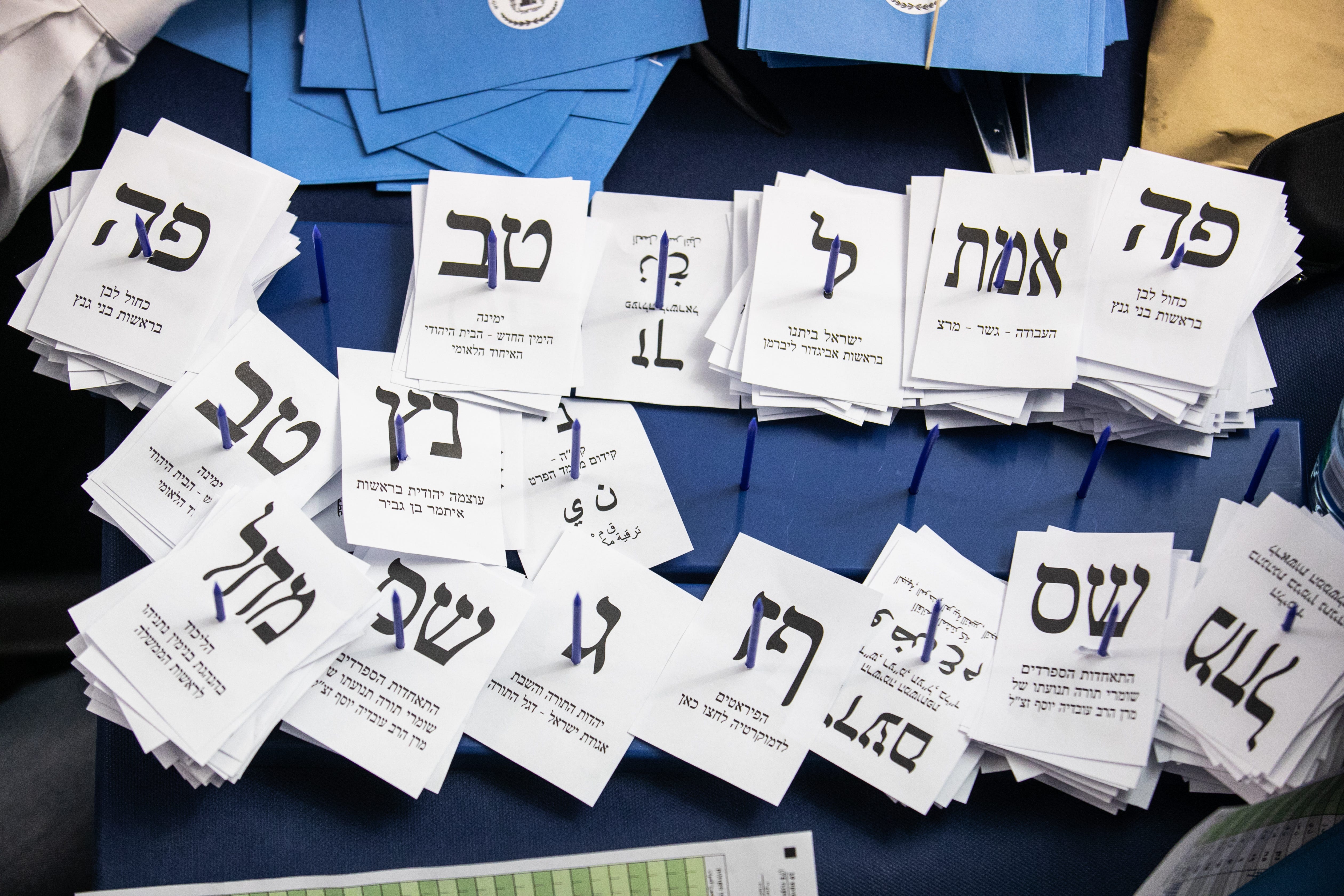
Israelis count the remaining ballots at the Israeli parliament in Jerusalem, a day after the general elections, early on March 4, 2020. (Olivier Fitoussi/Flash90)
It’s Monday, August 24, and in the first week of June 1981, Israel’s television audience—which at the time meant every Israeli tuned to the one and only channel they had—witnessed a bizarre scene.
There on screen sat the late Egyptian President Anwar Sadat, in the beautiful scenery of Sharm el-Sheikh—then still under Israeli control—talking to himself. The man who had made history by signing the first Arab peace treaty with Israel even threw his head back and laughed, still, apparently, talking to no one.
Rest assured: nothing was wrong with the Egyptian leader. In the chair beside him sat Israeli Prime Minister Menachem Begin, Sadat’s partner in peace, and the two were deep in a warm and animated exchange.
The only problem was timing. The summit fell less than 30 days before that year’s general election, and Israel’s strict anti-propaganda laws forbade showing or airing any candidate in the month before a vote. So the broadcast simply erased Begin, leaving Sadat to laugh at an empty chair.
Those draconian rules have long since been repealed, and the political ad has become a fixture of Israeli elections. It is also the perfect lens through which to read the current election. Four recent ads in particular map onto three of this election’s most important battles: a fight for the swing-voting moderate right, a crisis inside the ultra-Orthodox camp, and the all-out war for the premiership.
Campaign ad from the Achdut party led by Gilad Erdan.
The first battle is for the swing vote—the six or seven seats that will likely decide the election, held by the scattered and demoralized moderate right. These are not necessarily “never-Netanyahu” voters, but they are wary of returning to Likud after October 7. They are the prize in a tug-of-war: Naftali Bennett’s camp holds them now, and Likud wants them back, while the new Achdut party wants to offer them a third way.
“Bennett voters,” the Achdut ad begins, in the style of a pharmaceutical commercial, “suffering from stomach pains? Trouble digesting the union with Lapid? Feeling a sharp pain down your left side?” The cure: a new medication called Achdut, led by Gilad Erdan, Israel’s former ambassador to both the U.S. and the UN.
The mockery does two jobs. Partly Achdut (“Unity”) needs to separate itself from Bennett’s Beyachad (“Together”)—the names are synonyms—but mostly it aims to hit Bennett where it hurts. Having tied himself to Yair Lapid, he is easy to outflank on the right. “Contains real right, and a real draft law,” the ad promises, a quick jab at Likud’s failure to pass workable conscription legislation. Then it turns on Likud directly: text appears at the end declaring the medication “also suitable for Likud voters, whose party’s primary list is causing them sleepless nights,” taking aim at the lunatics and cronies who populate some of Likud’s list and have alienated moderate Likud voters.
But the line that distinguishes the party is “without the side effects of a full left-wing government.”
There is more than one way to vote for a government. The simplest is a vote for a party—you back the people you like best. A second is a vote for a coalition: a right-wing voter might choose Ben Gvir not because he agrees with all of Otzma Yehudit’s policies, but to drag the likely coalition rightward. And a third, the most strategic, is a vote for an outcome—casting your ballot not to seat a party or even shape a bloc, but to force a specific governing arrangement into being.
That is exactly Achdut’s pitch. As Erdan put it, “Only Achdut will refuse to sit in any narrow government, and will instead bring about a broad unity government drawn from both blocs.” It speaks to right-wingers who want to break the impending deadlock where neither the current coalition nor the opposition has a majority with a broad unity government. It also helps with the synonym problem: unlike a vote for “Together,” a vote for “Unity” is a vote for unity.
Shas campaign ad depicting the return home of a soldier on Friday night.
The second battle is a crisis inside the ultra-Orthodox camp, where the parties have stalled in the middle of the road and satisfied no one. They have failed to reassure their Haredi base that the draft threat has been beaten—yeshiva students are still sitting in prison and funding is still blocked—and they have failed to convince anyone more moderate that they care about the soldiers.
Shas feels it most acutely. The Mizrachi ultra-Orthodox party is torn between its two constituencies—an ultra-Orthodox base that does not serve, and a broader Mizrachi electorate that often does—and the ad is its attempt to bridge them. A soldier comes home to his brother in Haredi dress. “You learned a lot this week, huh?” he says. “For you and all the soldiers,” the brother replies. It closes on a boast: 30,000 soldiers and IDF employees voted Shas at the last election.
The figure is deceptive. It rests on the double-envelope count—the procedure that lets people outside their home precinct vote, that includes soldiers, but also prisoners, and hospital and nursing-home patients. By that definition, more than 15,000 “soldiers” voted for anti-Zionist Arab parties last election.
Using a soldier's image for political ends is illegal in Israel, but politicians can’t resist. The homecoming-reservist hug is the local equivalent of the American candidate in a blue shirt and khakis with a gold Labrador at his heel—a campaign fixture.
But a truer statement of Shas’ creed would have had the learning brother embrace his soldier sibling and whisper, “we are both serving equally.” Instead the ad only implies it, because the explicit equivalence—embodied in the party’s attempt to enshrine it in Basic Law: Torah study—was deeply unpopular. Will the ad charm its serving voters back? Polls point to no.
Likud attack ad targeting Gadi Eisenkot.
But above all there is the battle for the premiership. This is a fight not for swing votes but against the other side’s voters: Eisenkot’s supporters are, by and large, not on the fence, swaying between him and Netanyahu—and neither are Bibi’s. It is a contest of base mobilization and of demoralizing the enemy camp.
Benjamin Netanyahu’s AI-generated ad shows Gadi Eisenkot sprinting through an idyllic meadow, past the outstretched arms of a young man in an “Israeli unity” T-shirt, to throw himself instead into the embrace of Mansour Abbas, head of the Islamist party Ra’am. Subtlety has never been Netanyahu’s election style.
Old dogs don’t learn new tricks, and Netanyahu is one of the oldest dogs left in Israeli politics. This is 2019’s “Bibi or Tibi”—framing the choice as Likud or Ahmed Tibi’s Ta’al—and 2015’s warning that “the Arabs are voting in droves,” with a healthy dash of the same year’s “Bibisitter,” the implication being that only a responsible Netanyahu can guard the state from a government dependent on anti-Zionist votes. With the polls pointing to stalemate—neither bloc reaching the magic number of 61—and Eisenkot conspicuously eyeing the Arab option, it is the richest vein Netanyahu has to mine.
But as in writing, what you leave out of a political ad matters as much as what you put in. Netanyahu can’t paint Eisenkot as a fake right-winger the way he does Bennett, and he can’t call a former IDF chief of staff uncredentialed on security. He even had to take down this version of the ad, due to the implication that it was making light of Eisenkot’s loss of his son in the Gaza war. Eisenkot is a relatively small target. So Netanyahu reaches for an oldie but a goodie: fear of the anti-Zionist Arabs.
Recent Eisenkot attack ad targeting Likud.
Eisenkot struck back, parodying Likud’s 1992 campaign song “Likud—that’s right!”—flipping it to “Likud—that’s a disaster.” With no more subtlety than Netanyahu, he cuts fast between clips of ultra-Orthodox protests, corruption and the lunatics on the Likud list, then answers the Arab charge head-on, jabbing at Bibi’s record with a clip of Netanyahu shaking the hand of an Arab party leader, accompanied by the lyric, “says it’s right but in practice governs from the left.”
In this, the most important battle of the election, there is little creativity—just a slugging match of messages, a test of whose base can absorb the blows and whose cracks first along the obvious fault lines. So far, no matter how good or bad the ads, a decisive knockout on either side looks unlikely.
The Altalena burning off the coast of Tel Aviv, 1948.
Along the central Tel Aviv promenade, near Herbert Samuel Street, a memorial in the shape of a sinking ship’s prow juts from the stone sea wall—a monument to the ship that brought Israel the closest it ever came to civil war. The life preserver from that ship hangs outside the Knesset chamber. This morning, the ship itself, the Altalena, was found.
The Altalena—named for the pen name of Revisionist Zionism’s founder, Ze’ev Jabotinsky—was secretly loaded with fighters, immigrants and Holocaust survivors, along with weapons and supplies to smuggle into the month-old state of Israel. It sailed from France on June 11, 1948, the very day a U.N.-brokered truce in the War of Independence banned the import of new arms.
The ship reached the coast of Israel on June 20, where Menachem Begin—leader of the opposition and head of the Irgun militia group—was waiting on the beach to meet it. He wanted a share of the weapons routed to his own organization, including its still-independent force in Jerusalem; David Ben-Gurion, prime minister of the young state, demanded every rifle be handed to the IDF, reading the whole episode as the seed of “an army within an army.” The cabinet, meeting in Tel Aviv, resolved to force the issue. When the ship came to rest off the Tel Aviv beach—in full view of the city, foreign journalists and U.N. observers—Ben-Gurion ordered it taken by force. It was shelled with his chief political rival still aboard. Yet even after the ship burned and 16 Irgun members lay dead, Begin told his followers: “Do not raise a hand against a brother, not even today. It is forbidden for a Hebrew weapon to be used against Hebrew fighters.”
My great-grandmother Malka Segal and Menachem Begin at the dedication of a garden in Carmel named after my uncle, Yedidya Segal.
A personal note: Begin took that phrase—do not raise a hand against a brother—from my great-grandmother, Malka Segal. Months before the Altalena, her son Yedidya had been abducted by the Haganah in an internal reprisal and died under torture. When Begin came to visit her and asked what she wished to be done, she answered: anything but a war of brothers.
It is hard to overstate the place this event holds in Israel’s history. For some, it carries the weight of Lee’s surrender at Appomattox; for others, of Washington quelling his own officers at Newburgh, ending a mutiny over unpaid wages with an appeal to their patriotism. The artillery piece that fired on the ship was dubbed the “Holy Cannon” by Ben-Gurion, who said it should stand beside the Jewish Temple if it were ever rebuilt. For decades, it was enshrined at the IDF officers’ school—a standing lesson in military subordination to elected civilian leadership and the rejection of any dual chain of command. Last year, it was moved to the Menachem Begin Museum.
I hesitate to sanctify a ship. But that the Altalena should surface now, at so contentious a moment in Israel’s history, feels like some kind of sign. Whatever the election brings, we would do well to remember my great-grandmother’s plea, and Begin’s vow: anything but a war of brothers.
English Editor: Ari Tatarka
If you enjoy the newsletter, you can show your support by becoming a paid subscriber—it really helps keep this going. I’m also offering a special monthly briefing for a small group of premium members. I’d love to have you join us—just click below to find out more.
Thanks for reading It’s Noon in Israel! Subscribe for free to receive new posts and support my work.


In the same way, it was unacceptable to have an "army within an army" in nineteen forty eight, it should be considered unacceptable now to have a state within a state with the ultra-orthodox.
Shas sera dans l obligation de faire un choix concernant le vote des double vote comment laisser cette illégalité continuer merci pour votre analyse pertinente les Israéliens veulent voter pour un véritable programme de sécurité durable et des décisions contre la discrimination positive pour les arabes israéliens qui ont des avantages dans les examens dans les campus etc pendant que ceux qui assurent Tsahal ont des années a l armée ça doit cesser tous les Israéliens devraient avoir les mêmes droits