Lebanon’s Premature Independence Day
Also, the two children in Yashar!’s belly and how Beijing buys influence in Israel without spies.


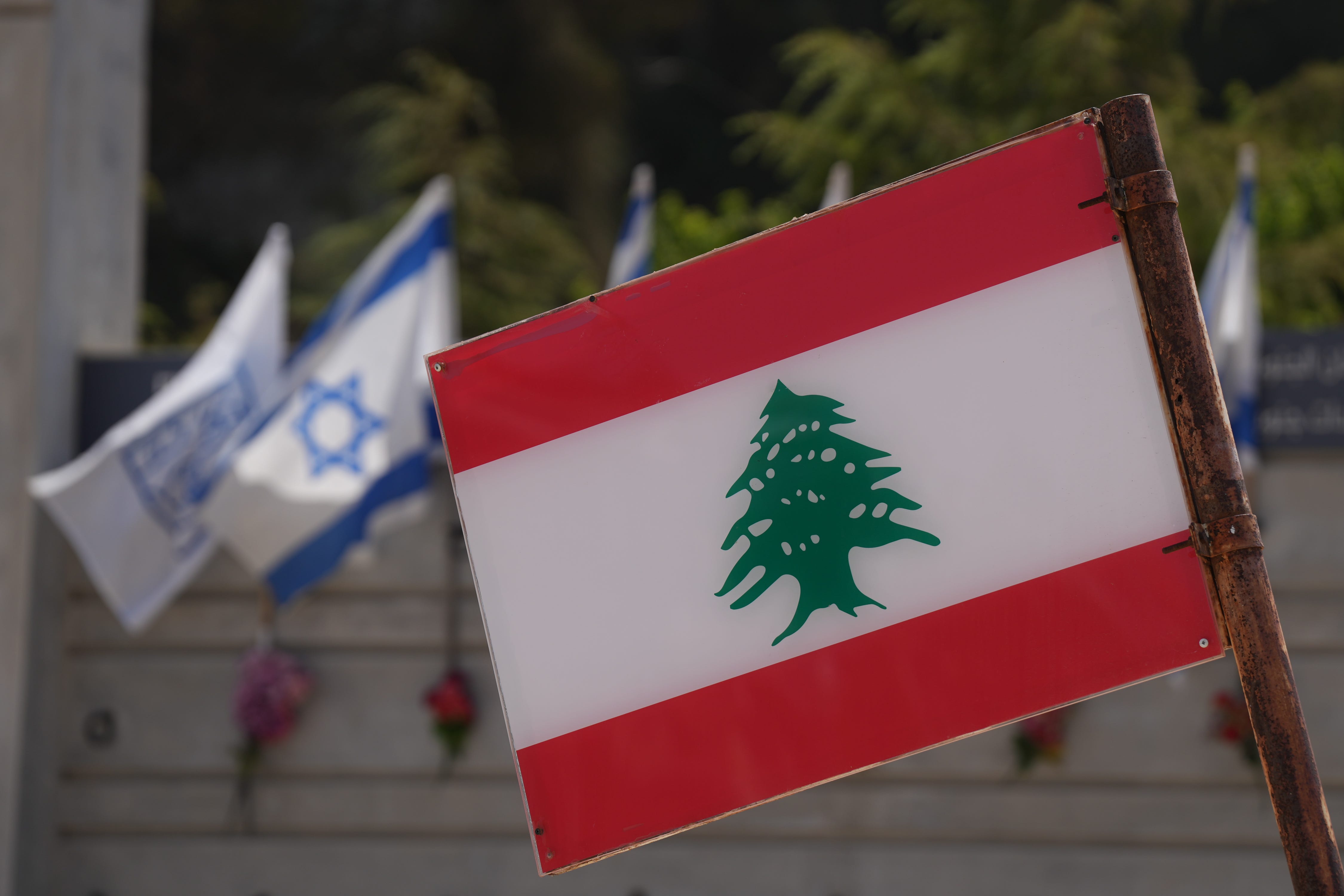
Israeli and Lebanese flags at the South Lebanon Army (SLA) Memorial near Metula following the signing of an agreement between Israel and Lebanon, June 28, 2026. Photo by Ayal Margolin/FLASH90
It’s Monday, November 23, and yesterday, on Lebanon’s Independence Day, the IDF’s Arabic-language spokesperson posted a holiday greeting filmed at a state school in southern Lebanon. She wished the Lebanese “freedom, dignity, peace, and the power to decide on war and peace in the hands of the Lebanese state alone.” The reaction was, predictably, absurd.
Prime Minister Nawaf Salam condemned the video as a “violation of the sanctity of educational institutions and of children’s rights.” The education minister said Israeli forces had walked into classrooms and filmed propaganda with students present. She cited the Convention on the Rights of the Child and the Geneva Conventions. The Lebanese Teachers’ Syndicate called it a breach of sovereignty and demanded an investigation. Hezbollah, too, wanted an investigation. It was shocked, shocked to find armed men in Lebanese schools.
In Hezbollah’s schools, it’s the children who are armed.
Pupils in Hezbollah’s Al-Mahdi network have staged mock assaults on Israeli positions, in military uniform, as part of their education. Hassan Nasrallah, Hezbollah’s late leader, called the network “deeply tied to our faith and jihadist mission.” One graduate, fighting in Syria, thanked his teachers on a bombed-out wall for a journey “which started in the Al-Mahdi schools and brought us to the fields of jihad.”
But it is Israel, speaking of the “hope in the children’s eyes, and their simple dreams of a safe future and better days,” that poses the national security threat.
Lebanese officials get it both ways. Israel is the enemy they can afford to condemn, and the only one doing anything about the enemy they can’t.
Hezbollah got only an indirect mention in President Joseph Aoun’s Independence Day address, when he declared that “the time for weapons outside the authority of the state is over.” In 2025, such confrontational rhetoric was refreshing. After two years of lax implementation, it’s exhausting. Militant rhetoric appears to be the former general’s greatest military accomplishment.
By late October, implementation of the Framework had not gone beyond the first pilot zones, and an eighth round of Lebanon-Israel talks ended without a result. Hezbollah is recovering, and momentum has begun moving in the opposite direction. On November 11, Hezbollah Secretary-General Naim Qassem tied any discussion of the group’s weapons to an Israeli withdrawal, and called on the state to give the army everything it needs to confront Israel.
Beirut is trying to look busy. On November 13, the army published photos of weapons seized in a warehouse raid in Musharrafieh, in the heart of Dahiyeh. Even if the weapons are Hezbollah’s, and even if the seizure was real rather than coordinated, it has no meaningful effect on the organization’s military capabilities. The gap between the army’s announcements and reality on the ground is as wide as it was during the ceasefire. Meanwhile, Hezbollah is rebuilding its command and control. According to Alma, it is laying an independent military communications network through electricity, telecom and sewage lines that belong to the Lebanese state.
The unfortunate truth is that for much of the 83-year history of Lebanon, Independence Day has been premature. Should it ever be celebrated in earnest, it will be as much a victory for the Israeli people as for Lebanon.

MK Elisha Medan prepares to go to sleep inside his protest tent outside the Knesset in Jerusalem, where he is calling for the formation of a national unity government, November 18, 2026. (Chaim Goldberg/Flash90)
Two children are fighting in the belly of the Yashar! party, and both poke out from time to time. The first is the anyone-but-Bibi-ist wing, the one that learned from Benny Gantz’s lessons, is shocked by Benjamin Netanyahu’s conduct, and believes the overriding goal is to put an end, as soon as possible, to his lengthy rule. This wing owns the slogan on Gadi Eisenkot’s Twitter account. It is the one that wrote this week: “Under no circumstances may Netanyahu continue to hold the reigns of power for even one more minute.”
The second is the unity-seeking wing. Anyone who has visited the Yashar faction and knows its human makeup knows how popular this idea is among many of its members. Like a moth to a flame, they were drawn this week to MK Elisha Madan’s unity tent. They feel much more comfortable there than with Ra’am MK Walid Taha or Democrats leader Yair Golan. The first from the opposition to visit was MK Hili Tropper. After him the dam burst: Knesset Speaker Matan Kahana, Eisenkot himself, and in the end even Omri Ronen of the Democrats.
Eisenkot’s conduct shows where he is aiming for now: a 48-seat government supported by the Arab parties. Everything leads there: the long leash given to Avigdor Liberman to negotiate with the Haredim, and the (so far) fruitless negotiating sessions with the Likud. The goal is to announce that we tried, but there is no choice and we must go form a temporary government on the way to yet another election round. In his words: “Israel must under no circumstances be dragged into another election round while he [Netanyahu] is prime minister.”
Eisenkot reminds me of Shelly Yachimovich, the former Labor Party chair. In her many years in politics, she never broke a promise: she never sat with Netanyahu, never compromised an inch on her social-democratic worldview, and never sat in a studio and was embarrassed with an archive clip. Maybe it’s related and maybe not, but she never served even as a deputy minister. Politics is not only the art of compromise; sometimes it is also the craft of zigzags, climb-downs and broken promises.
Eisenkot, it should be said in his favor, revealed to the public a year before the election his plan to form a minority government that would rely on abstention or outside support from the Arab parties. If it happens, no one can say he misled his voters. He also promised not to sit with Netanyahu, and to go to elections rather than fold before the Haredim. His statements since the election on all these issues hint at no turnaround. The combination of all these promises seemingly means he will be forced to go to elections again without reaching power, since Liberman, former Prime Minister Naftali Bennett and parts of his own faction still strongly oppose such a government.
So what is the plan? As Ariel Sharon’s military secretary, one may assume he remembers the moment when the prime minister brought the disengagement plan to a vote despite his ministers’ threats, without blinking, and they folded. If the mandate ends without a more stable government, he may bring the 48-seat government to a vote and announce that whoever objects goes to elections, with everyone knowing that the objector is the one who left Netanyahu in power. The problem is that Bennett and Liberman have no wish to crown him when they are the ones paying the price for breaking their promise not to lean on the Arabs, and the result could resemble the failed vote on “the dirty trick” in 1990. It may begin like Sharon, but it may end like Shimon Peres.
This is an excerpt from my weekly column in Israel Hayom.
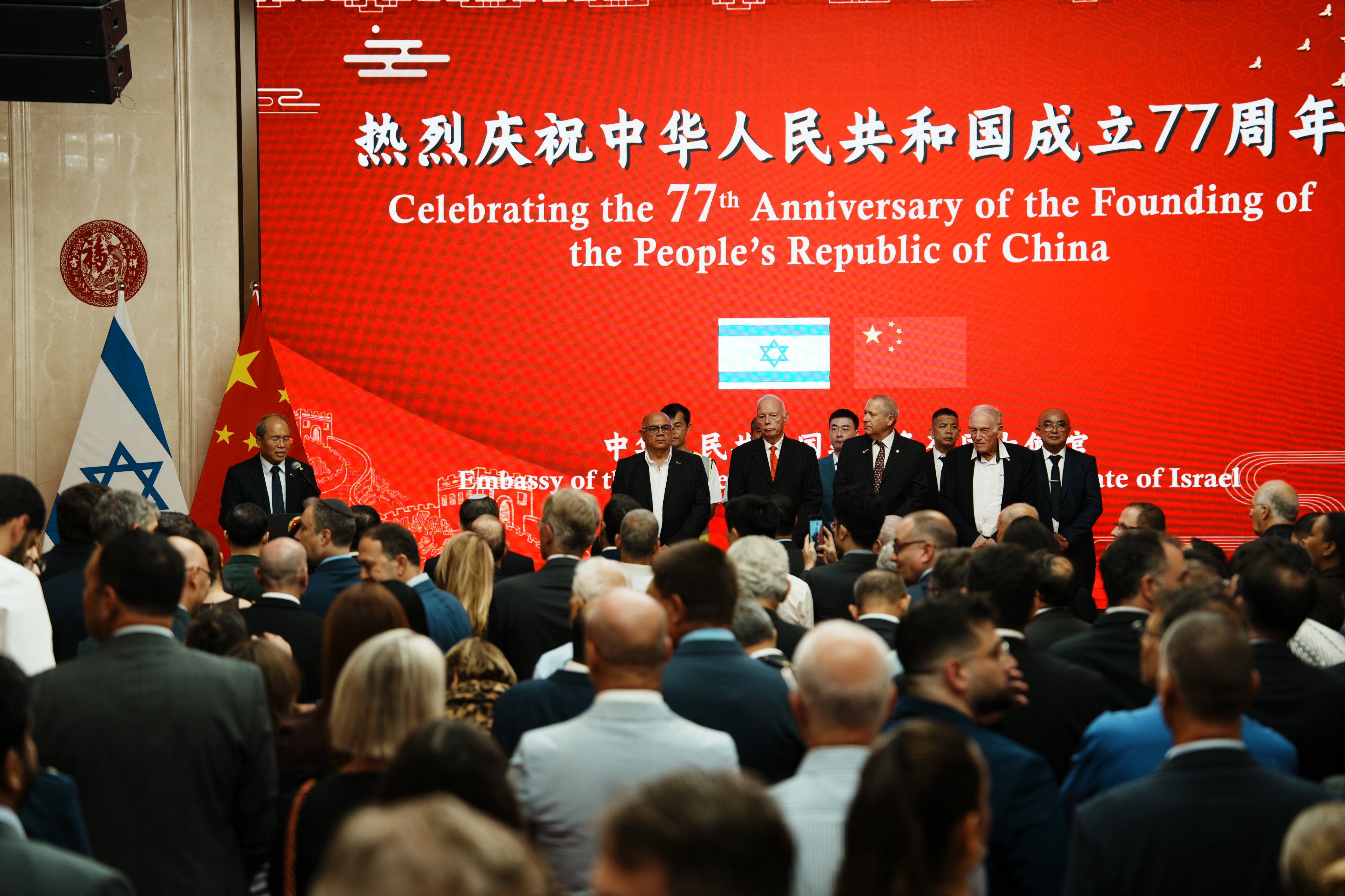
More than 400 guests from Israel’s government, Knesset, business and tech sectors turn out for the Chinese Embassy’s September 3 celebration of the People’s Republic’s 77th anniversary. (@ChnAmbXIAO/X)
After the chaos surrounding the Nvidia breach, every country is taking a fine-toothed comb to its institutions in search of irregularities. The terrifying truth is that in Israel, Beijing has no need of honeypots to wield a frightening amount of influence.
That’s the argument of sinologist Amit Elazar, writing in Makor Rishon. According to Elazar, the espionage and technology-theft suspicions in the Nvidia affair reveal that the China-West rivalry is a security fight as well as a commercial one. But the more effective front is quieter. Beijing is trying to shape what Israelis think, what they say and, above all, what they don’t.
This, Elazar writes, is how foreign influence and self-censorship take hold: “not through a gun pressed to the temple, but through a door that may close.”
The machinery behind it is the Chinese Communist Party’s United Front, a wide network of organizations, associations and communication channels. Its job is to build ties with politicians, businesspeople, academics and journalists, and to move the Party’s positions through them. That does not mean every tie to a Chinese counterpart is a secret influence operation, but the collective weight of those connections can function the same way.
China’s economic footprint is already large: the Tel Aviv light rail, the Bayport terminal at Haifa Port, plus an Israel-China Chamber of Commerce and an Association of Chinese Companies in Israel. All are avenues of implicit pressure.
Academia has the same problem. Some researchers told Elazar they are careful about what they say on China in public, for fear of losing visas, partnerships and research access.
At Haaretz’s Israel Climate Conference in February, journalist Nir Hasson interviewed Chinese Ambassador Xiao Junzheng about China’s climate achievements. Forced Uyghur labor in the solar panel supply chain didn’t come up.
The challenge facing the West’s open societies is what to do when an adversary uses their openness to push its narrative while keeping its own society closed. Israel has been one of the chief casualties. After October 7, the Party avoided condemning Hamas by name. Its criticism of Israel then got sharper, and state media spread messages echoing Israel’s enemies, some of them openly antisemitic. Meanwhile, its covert social media operations pushed the same narratives into the West.
Elazar’s prescription isn’t to cut ties. He wants transparency on foreign funding in media, protection for academic independence, and close scrutiny of strategic investments. The danger, he concludes, is less what Beijing does than what Israelis stop doing to avoid upsetting it.
English Editor: Ari Tatarka
If you enjoy the newsletter, you can show your support by becoming a paid subscriber—it really helps keep this going. I’m also offering a special monthly briefing for a small group of premium members. I’d love to have you join us—just click below to find out more.
Thanks for reading It’s Noon in Israel! Subscribe for free to receive new posts and support my work.


Discussion about this post