The Freest Man in Israeli Politics
Also, why a disagreement over Iran is not a putsch.
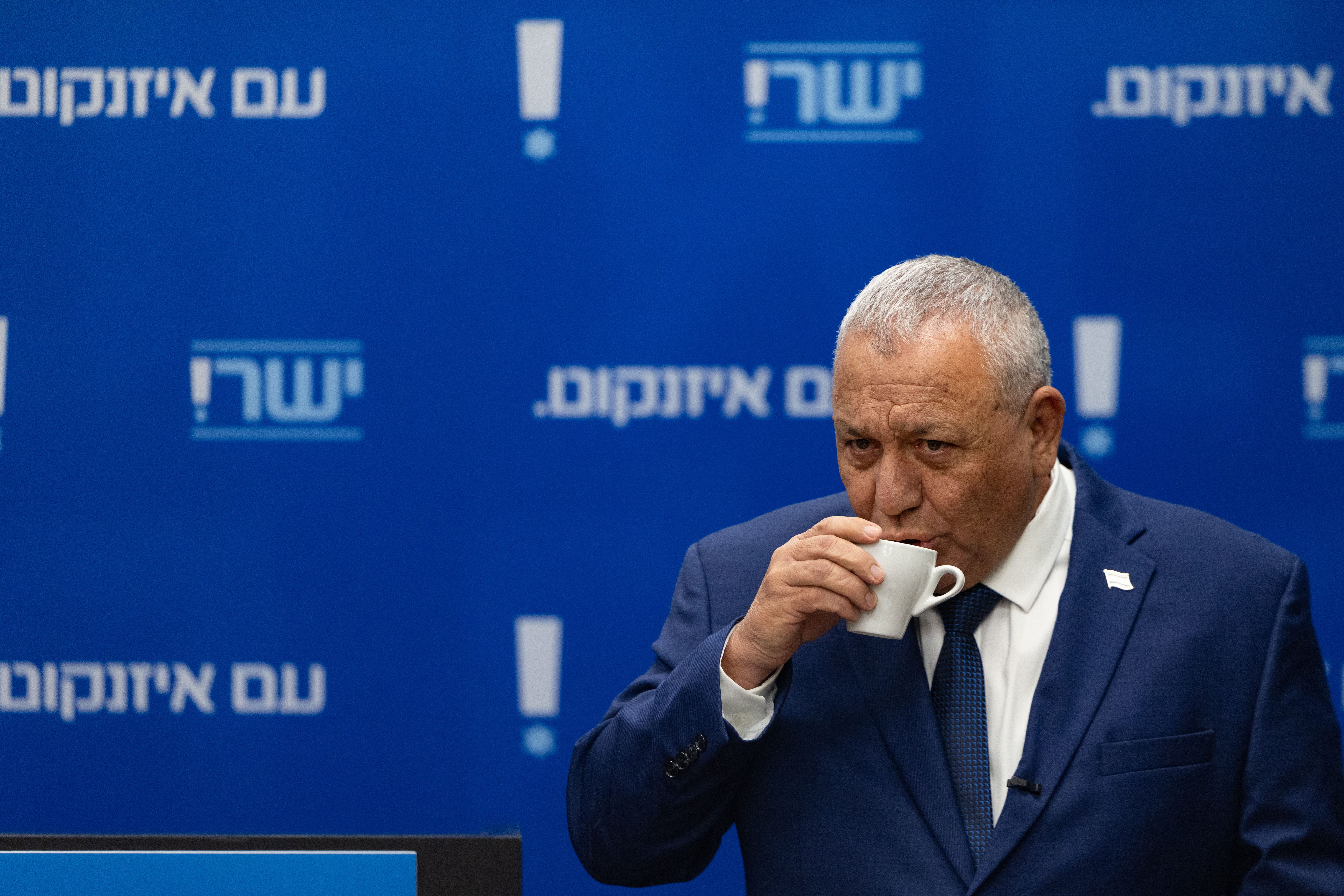
Yashar party leader Gadi Eisenkot arrives to the party's faction meeting at the Knesset in Jerusalem, November 23, 2026. (Chaim Goldberg/Flash90)
It’s Tuesday, November 24, and on paper Gadi Eisenkot is the freest man in Israeli politics. While Benjamin Netanyahu is trapped inside his 53-seat bloc, the Yashar chairman has three potential paths open to him: the Arab parties, the Haredim and Likud. The problem is that Avigdor Lieberman, the Yisrael Beytenu chairman, refuses to follow him down the first; the High Court guards the second, while Netanyahu stands in the way of the third.
Last night, Yashar held two sets of negotiations, one with Likud, the other with United Torah Judaism.
The latter seemed to make more progress toward agreement between the two parties, but not with the third, the High Court.
The current framework drops enlistment quotas altogether, making it significantly laxer than the outgoing government’s “draft evasion law,” as the opposition labeled it. In exchange, leading rabbis would publicly call on young men who aren’t studying to enlist. The Haredi demands go further. They want a law that abolishes arrests for draft evaders and replaces them with some other sanction, for every evader, Haredi or secular. What sanction the Haredim would accept, short of a firm slap on the wrist, nobody can say. Most challenging, they want this law passed before the government is sworn in, with all 67 prospective coalition members, Arab MKs included, committed in advance.
All of this runs into a two-layered legal barrier. The first is procedural. The Attorney General’s office has told both sides that no such law can pass before a government exists, and Yashar has said it won’t try. The second is substantive. In June 2024, the High Court ruled 9-0 that there is no legal basis for exempting yeshiva students. Since then, every attempt at a draft bill has failed to pass legal muster; a weaker proposal will not have a better chance simply because the parents are of a different political persuasion.
The other path has made significantly less progress on agreement between the two parties. The unity path has long since moved past whether there will be a rotation and is stuck on who goes first.
Not only is Likud the bigger party, Netanyahu argues, but the only window to strike Iran is now, while his good friend Donald Trump is still in the White House. It makes no sense, for him or for Israel, to hand that window to Eisenkot, only to return just in time to face a hostile Democrat.
“I have other options,” Eisenkot replies. “But more importantly, I don’t trust you.” He has far more to gain politically from forming a controversial minority government than from serving second to Netanyahu, only to be stabbed in the back a year in.
Meanwhile, the self-appointed arbiter, Naftali Bennett, is setting the terms: negotiate in good faith, or he will let Eisenkot form a minority government.
Netanyahu is posturing. He has quashed any hope that he’ll leave politics if he loses this round, insisting he’ll remain on as opposition leader. But his willingness to sit in the opposition may crumble if Eisenkot starts making real progress down a path other than unity.

Fighter jets fly over Mount Herzl Military Cemetery in Jerusalem on the eve of Israel’s Memorial Day, April 20, 2026. (Chaim Goldberg/Flash90)
Yesterday, Avigdor Lieberman told his faction that an independent strike on Iran would be a “manifestly illegal order.” At around the same time, former Mossad chief David Barnea called for a strike “as soon as all conditions allow.”
On one side of this argument are Netanyahu and Mossad chief Roman Gofman, now joined by his predecessor. Gofman has been pressing Washington for joint strikes, and in internal discussions he reportedly warned that Israel may not get another chance to strike alongside the Americans.
On the other side is, notably, the IDF. Chief of Staff Eyal Zamir reportedly sees no imminent threat and wants to wait unless the U.S. is ready to begin on its own. Gadi Eisenkot concurred on Monday, saying he sees “no direct and immediate threat” requiring action before a government is formed.
This isn’t an information gap. Eisenkot sat with Netanyahu for a two-hour security briefing earlier this month.
Setting aside the suspicion that both men are timing a war to their political calendars, there are two possible explanations. The first is that the agencies themselves are split on the interpretation of intelligence. The second is a different definition of the word “immediate.” For Netanyahu, it means the coming weeks to months. Eisenkot hears it and wonders why the urgency peaks just before his mandate to form a government runs out. But that does not mean Netanyahu is wrong. A threat can be urgent and convenient at the same time.
This is evidence No. 1,540 that Israel needs a unity government. Picture Israel going to war with Iran while half the public, maybe more, believes it was launched under false pretenses for political reasons. Or picture it skipping the strike, a different government taking over, and the country spending the rest of its life arguing over whether Iran got the bomb, or chemical weapons, because of the opposition’s maneuvering.
English Editor: Ari Tatarka
If you enjoy the newsletter, you can show your support by becoming a paid subscriber—it really helps keep this going. I’m also offering a special monthly briefing for a small group of premium members. I’d love to have you join us—just click below to find out more.
Thanks for reading It’s Noon in Israel! Subscribe for free to receive new posts and support my work.


Discussion about this post