
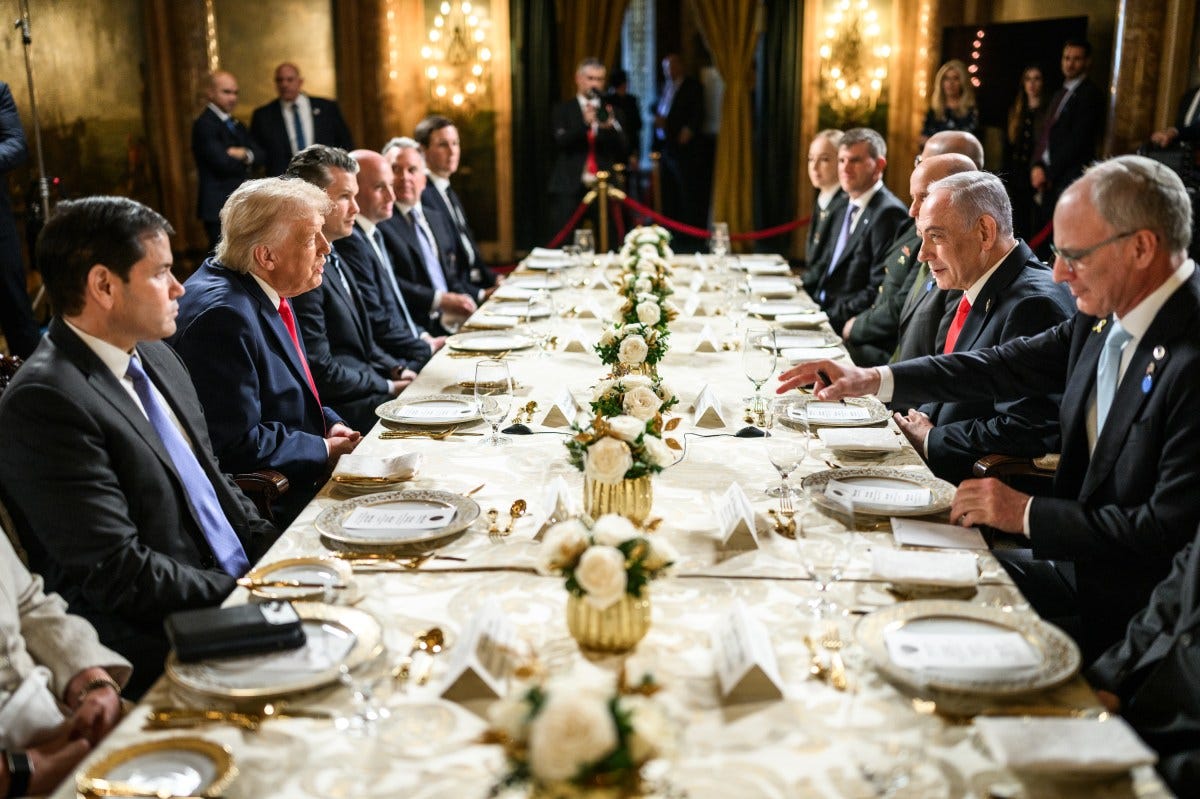
Donald Trump hosts a bilateral meeting with Israeli Prime Minister Benjamin Netanyahu at Mar-a-Lago. (White House)
It’s Sunday, October 4, and if the Islamic Republic could vote, whom would it choose: Benjamin Netanyahu or Donald Trump? It sounds like an abstract problem, but the choice facing Tehran is the same one Citizen Change posed to American voters in 2004: “Vote or Die.”
With the U.S. blockade plunging Iran into an ever-deepening economic crisis, Tehran must break the status quo. The question is when. Escalating before the Israeli election and the midterms would send the markets into an inconvenient panic and Israeli jets to Tehran. Any conversation outside of security would be quickly stifled, burying some of Netanyahu’s other indiscretions while bringing gas prices and Trump’s failures to the front of American voters’ minds on November 3. A war before October 27 is a vote for Bibi and against Trump.
Tehran, reluctant to boost Netanyahu’s security credentials, could wait until both elections are over, but that is casting a vote for Trump.
Observant readers will notice that there is a gap between the two trips to the ballot box. Tehran has a single week, between October 27 and November 3, in which it can launch a war without helping either candidate.
There is also the risk that, unlike winter, election season makes war more likely. Trump is currently holding back to give Republicans a chance of holding the Senate, telling reporters the war will be brought to a conclusion “right after the midterms.” While I struggle to imagine a fate worse than the hell on earth Trump has already threatened to unleash multiple times, if Iran extinguishes whatever electoral hopes are constraining the president, the response is unlikely to be the controlled escalation Tehran may be hoping for.
Despite declaring at the United Nations that “the resistance of the Iranian people will only increase in the face of sanctions,” President Masoud Pezeshkian reportedly approached Steve Witkoff, Trump’s special envoy, with an Iranian compromise the same day. Like an Iranian moderate, an Iranian compromise exists mainly by comparison.
The offer was essentially identical to the memorandum of understanding: Iran would open the Strait of Hormuz in exchange for sanctions relief and the unfreezing of assets, with the fig leaf that maybe, perhaps, if the U.S. is on its best behavior, Iran might let nuclear inspectors into the country, potentially. Unsurprisingly, Nazi Germany offering to sell France back in 1945 would not have been a tempting offer.
Despite his past enthusiasm for such terms, Vice President JD Vance did not jump at the offer, and Trump dismissed it out of hand, though Iranian Foreign Minister Abbas Araghchi is still in denial, insisting no formal rejection has been conveyed. The very act of negotiating is an indicator of desperation rather than deradicalization, brought on by the blockade, tightening sanctions and isolation from regional states that have grown sick of Iranian antics. According to Jared Kushner, Trump’s son-in-law and envoy, “The U.S. has achieved greater impact in a matter of weeks than during the lengthier campaigns commenced from 2010.”
But while the attempted outreach indicates desperation on the part of Araghchi and Pezeshkian, the unchanged terms suggest that while Tehran burns, Islamic Revolutionary Guard Corps commander Ahmad Vahidi is still fiddling, confident he can endure the economic pain and outlast American patience.
Trump’s dwindling patience may be getting a refill. According to JPMorgan, oil traffic is back to 98 percent of prewar levels, an impressive accomplishment by the U.S. Navy in only four months, all the more so given how erratic those months have been. Even the apparent glimmer of hope from the Houthis has not materialized. Though they seized the coastline overlooking the Bab al-Mandab last month, they have yet to effectively close the strait, and according to Yemen’s armed forces, they lost nearly 3,000 killed and wounded in four days. Saudi Arabia is now preparing a counteroffensive that could mobilize more than 100,000 Yemeni troops under Saudi air cover. Washington has twice declined Riyadh’s request to join, though U.S. officials say that could change if the operation falters.
The truth is Iran has a larger problem than timing: its vote doesn’t matter. Trump still has months before a Democratic-controlled Congress could begin impeachment proceedings, and even while trapped in endless inquiries, he still holds the power over the military and foreign policy. Meanwhile, whoever becomes the next Israeli prime minister, in the increasingly unlikely event the election produces a definitive outcome at all, Jerusalem is not going to turn pro-Tehran. No matter who they vote for, nothing will change in time for Iran to survive.
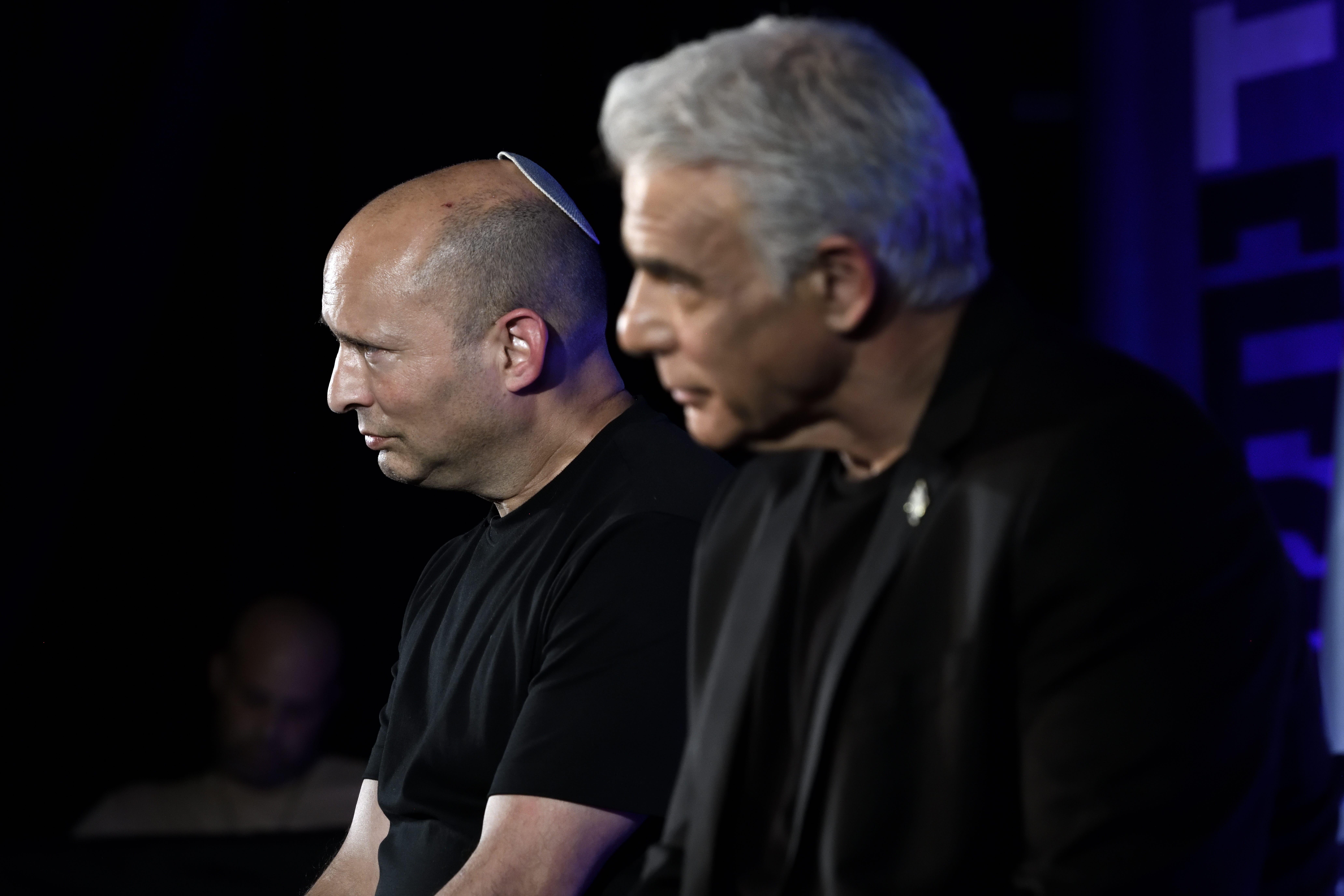
Former Israeli Prime Minister Naftali Bennett and former Israeli Prime Minister Yair Lapid attend an election campaign event for their joint "Together" party on August 20, 2026 (Gili Yaari/Flash90)
It’s still too early to know whether 2026 will be the new 1977. But even before the coalition packs up and goes home, one thing can already be said: October 7 sent the opposition home.
The last poll before October 7 gave former Defense Minister Benny Gantz’s State Camp—with former IDF chief of staff Gadi Eisenkot and Gideon Sa’ar—29 seats. Yair Lapid was already trending down but still had 18. There was no Avigdor Liberman, no Naftali Bennett and no Yair Golan. The poll tested what would happen if the Kaplan protest movement registered as a party. The result: 10 seats.
In the coalition, it’s still the same figures and the same parties, but the opposition is almost unrecognizable. Of Lapid and Gantz’s combined 47 seats, the polls now show barely five left. On the ruins of the left-wing parties Labor and Meretz rose a unified party made up mostly of protest-movement figures, but led by a man who reinvented himself after jumping south on October 7. Naftali Bennett, though he’s dropped significantly from last year’s peak, is offering right-wing policy to center-left voters alongside Liberman, and together they’re pulling roughly three times the votes they had before the massacre. So it used to be the State Camp, Yesh Atid, Meretz and Yisrael Beiteinu—now it’s Yashar, Together, the Democrats and Yisrael Beiteinu.
Gantz has been replaced by Eisenkot—on the surface not a particularly meaningful change, one chief of staff swapping for another at the head of the Camp. And yet the shockwaves of October 7 are felt here too. Eisenkot is, as is well known, a bereaved father from the war. The opposition back then focused on judicial reform; today’s opposition would be smart to focus only on the Haredi issue. The public has moved significantly away from the people who drove the protest movement, who are now all concentrated in the Democrats party. The massacre has pushed the possibility of a second change government much further out of reach, because of the wariness around the Arab parties and their refusal to call Hamas and Hezbollah terror organizations. This week’s Channel corporation poll found that even within the opposition, a third support disqualifying Ra’am—the very party without which neither Bennett nor Lapid would have become prime minister.
As is well known, the assumption that the elections at the end of the month will be the most decisive in the country’s history hasn’t been voiced here—if anything, the opposite. One reason is the enormous gap between where the public stands and the politicians who claim to represent them. The public has shifted sharply rightward, exactly as disgust, fatigue and disappointment with right-wing leaders have peaked, and the head-on meeting of these two contradictory currents won’t produce a pretty picture, or any kind of brave new world. In fact, Netanyahu did the opposition a favor by insisting on running again. Without him, it would have struggled badly to agree on a shared agenda and would have had to put forward an alternative plan of its own instead of the right’s.
Netanyahu’s long shadow is crowding out the need to say anything decisive—for instance, on the major challenge of the next term: the international fallout over the Palestinian question. The last term was defined by Gaza; the next will be defined by Judea and Samaria. The yes-or-no question of sitting with Netanyahu spares everyone the need to publish a clear plan for the territories’ future.
A hostile Democratic administration and, ahead of it, anti-Israel European governments won’t hesitate to pile on sanction after sanction. Anyone with sense who listened to the British foreign secretary’s auto-antisemitic speech and watched Israeli travelers get searched in Amsterdam in case they were carrying halva from Samaria understands that this is bearing down on us in giant strides. Right now, no one is preparing to head off the coming trouble—everyone is simply clinging to the desperate effort to grab the 61st seat from one side or the other.
This is an excerpt from my weekly column in Israel Hayom.
Plumber by trade, army cook by duty: The hero of Flight 1073 reveals the incredible story of the hijacking and rescue in an interview on Channel 12.
English Editor: Ari Tatarka
If you enjoy the newsletter, you can show your support by becoming a paid subscriber—it really helps keep this going. I’m also offering a special monthly briefing for a small group of premium members. I’d love to have you join us—just click below to find out more.
Thanks for reading It’s Noon in Israel! Subscribe for free to receive new posts and support my work.


I live in Israel and will be voting for Netanyahu, despite the very reasonable opposition of my son and my girlfriend. One major issue is that Netanyahu thinks he will live forever despite being operated on for cancer. He has not prepared a successor. His warranty has expired. Yet, not one of the other candidates/parties seem capable of organizing a one-car parade. I'm still trying to find proof that Eiskenkot speaks English at all. Can't imagine him talking to Trump as an equal. Israel has to finish the job in Gaza, Lebanon and Iran quickly. The next American election will be the absolute deadline for victory.
The hero of Flight 1073.....
Question for us gentlemen. How many of us have had dreams/fantasy's about doing what he did?